Hungary's OTP takes it up a notch, makes HUF 100 billion profit per month


Income, profit beat expectations
Virtually all of OTP's key third quarter results were better than analysts had expected, with revenue up 4% and profit 10% higher than the consensus estimate.
Total income went up 13% year on year, while operating costs rose by only 9%, resulting in an operating profit that was 15% higher than a year ago and an after-tax profit that was 13% higher.

the Profit was the second highest ever, and until 2019, the banking group had never made as much profit in a full year as it has now in a single quarter.
The only reason why this is not a quarterly record is that OTP posted an outstanding profit in Q2 2023, but the HUF 382 billion included many one-offs, with HUF 98 billion worth of adjustment items shoring up the profit.
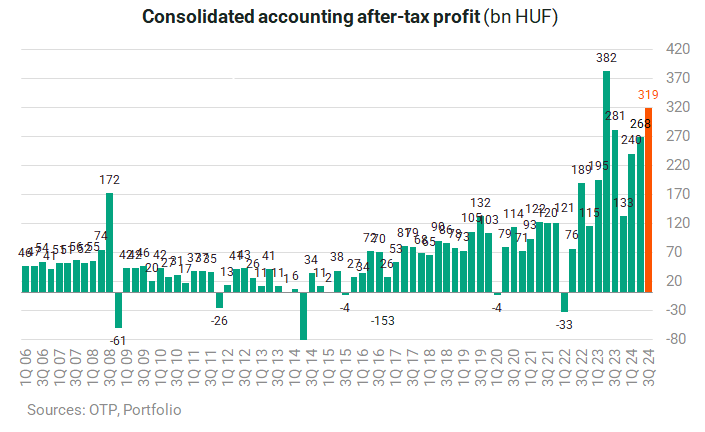
The 2024 consensus estimate of analysts in the Reuters database is for an annual profit of almost HUF 1,000 billion (HUF 996 billion to be precise), of which HUF 826 billion forints were generated in the first nine months. This means that OTP would only need a profit of HUF 170 billion in Q4 to reach the full-year prognosis. So we wouldn't be surprised
- if OTP's profit in 2024 exceeded HUF 1,000 billion, and
- if analysts started coming up with higher Q4 and full-year profit forecasts in the coming weeks.
otp's foreign operations generated a profit of huf 196.5 billion, accounting for nearly 62% of the banking group's profit.
The highest profit among foreign banks was achieved by the Bulgarian bank (DSK), HUF 49 billion, but the Russian bank also made a massive profit of HUF 34 billion, followed by the Slovenian bank, with HUF 26 billion and the Serbian operation, with HUF 20 billion. Worth mentioning is the Uzbek Ipoteka, which brought in HUF 19 billion in July-September and HUF 42 billion in the first nine months.
Total income reached a new all-time high, going up 13% to HUF 676 billion. Third-quarter results were shaped by the following larger special items:
- HUF 16 billion fair value adjustment on the Hungarian subsidized housing (CSOK) and baby loans measured at fair value;
- HUF 10.5 billion positive one-off item occurred on consolidated level in relation to the sale of the Romanian bank;
- with an aim of lifting provision coverage, in Q3 altogether -HUF 6 billion impairment was booked in relation to Russian bond exposures held in the balance sheet of OTP Core and DSK Bank (Bulgaria), weighing on the other provisions line of OTP Core (-HUF 5 billion) and DSK Bank (-HUF 1 billion).
Growing volumes, rising margins
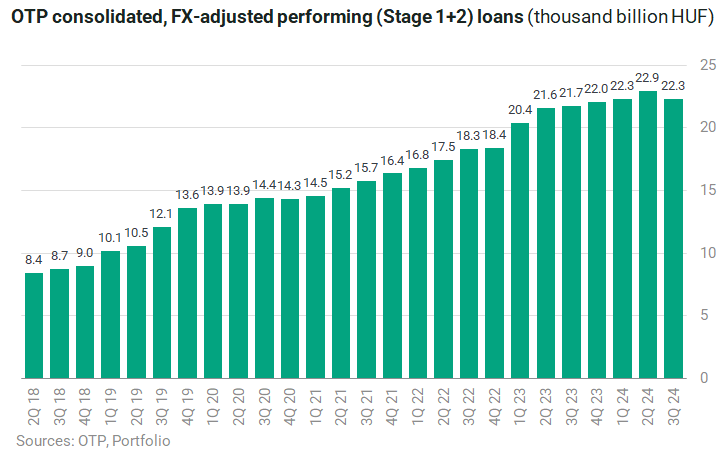
Consolidated performing (Stage 1+2) loans expanded by 2% q/q without the effect of the deconsolidation of Romania and FX-adjusted, thus the year-to-date growth reached 7%. The uptrend in household loan volumes remained intact: mortgage exposures demonstrated a 3% q/q expansion, whereas consumer loans grew by 6% over the quarter.
At the group level, margins are much higher now than a year ago, and it is particularly noteworthy that the net interest margin in the Hungarian operation is once again close to 3%, back in the range that prevailed before the war in Ukraine and the extremely high interest rate environment.

Cost control
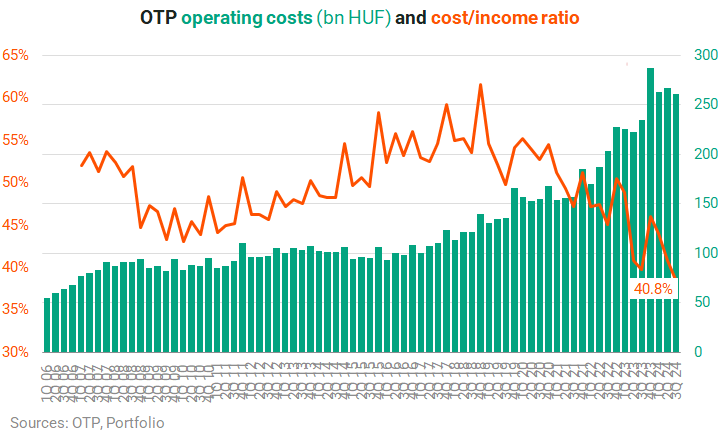
While revenues increased, operating expenses fell by 2% compared to the previous quarter, by HUF 6 billion, largely due to the sale of the Romanian bank.
The banking group is becoming more efficient, with the cost/income ratio falling below 39% in q3.
Low NPL ratio
Consolidated credit quality remained stable, main credit quality indicators continued to develop favourably. The ratio of Stage 3 loans under IFRS 9 declined by 0.3 pp q/q to 4.0%, as the ratio moderated in Ukraine and Russia, but went up in Slovenia. This value was over 12% in early 2018. The own provision coverage of Stage 3 loans remained stable q/q at 61%.
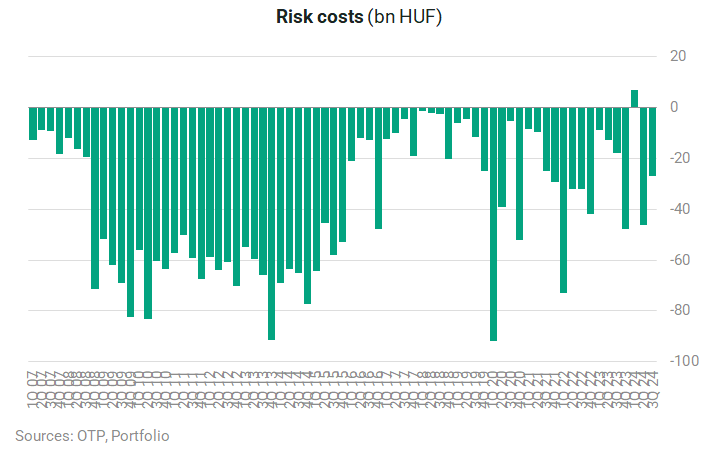
In Q3 total risk costs reached HUF 27 billion. Of this, provision for impairment on loan losses represented HUF 15 billion, owing mostly to Russia and Bulgaria, whereas in Hungary the sign of credit risk costs was positive, and Uzbekistan was close to zero. Provisions were released at OTP Core (Hungary).
Russia, Ukraine
OTP is doing very well in both countries that are at war with each other.
The Russian bank made a profit of HUF 34 billion in Q3 and HUF 91 billion in Q1-Q3. The Ukrainian bank made a profit of HUF 15 billion in the third quarter and HUF 42 billion in the first nine months.
So the two banks have already made HUF 133 billion for OTP this year.
It is not easy for OTP to leave Russia at a "reasonable price". On 15 October 2024, the Russian Minister of Finance confirmed that if a parent company registered in a so-called unfriendly country wishes to sell its share in a Russian company, the amount of the discount determined for the sale price will increase from the previous 50% to at least 60% of the 'fair' market value of the share. At the same time, the rate of the exit tax will rise to 35% of the market value of the share to be sold from the previous 15%.
However, until OTP remains in Russia, its operation there is generating handsome profits, and some can be brought hoe. RUB 37.1 billion dividend payment has been approved by the Central Bank of Russia since September 2023 (from this RUB 10.0 billion or cc. HUF 38 bn in Q3 2024), and further RUB 4.7 billion dividend payment is under authorization.
At the end of September 2024, the total gross Russian bond exposures at OTP Core and DSK Bank amounted to HUF 126 billion equivalent, of which HUF 108 billion equivalent not due exposures carried interest. As a result of the impairments made in Q3, the provision coverage on the Russian bond exposures increased by 6 pps q/q, to 62%
Management guidance remains
Based on the developments in the first nine months of 2024, the management reaffirmed its 2024 guidance made in the Half-year Financial Report, accordingly:
- The net interest margin may exceed the 2023 level of 3.93% (it was 4.28% in the first nine months);
- FX-adjusted organic performing loan volume growth may be higher than 6% in 2023.
- The consolidated cost-to-income ratio may be around 45% (it was 41% in Jan-Sept).
- Portfolio risk profile may be similar to 2023.
- Leverage is expected to decline; therefore, ROE may be lower than in 2023 (27.2%). (It was 24.9% in the first nine months this year.)
A cornucopia of data


Cover photo: Ákos Stiller/Bloomberg via Getty Images