No joke: Premium Hungarian Government Securities may yield negative real interest rates this year


Inflation and real interest
Inflation stayed close to the central bank's target range for years, but from the second half of 2021 (partly thanks to the recovery from the Covid closures) inflation in Hungary started to pick up from the beginning of 2022. In the second half of 2022, inflation was already well above 10% on a monthly basis, with December bringing inflation close to 25%.

This period of rising inflation also coincides with a decline in the popularity of Hungarian Government Security Plus (MÁP Plus), which peaked in December 2021. Unsurprisingly, in response to the high inflation, many people switched from the MÁP Plus to Premium Hungarian Government Securities.
The change was based on a perfectly rational idea, but many investors may have been mistakenly under the impression that the PMÁP, because of its inflation-linked interest rate, essentially always offers a real return. Unfortunately, this is not the case. The reason is that the PMÁP tracks inflation later in time, one could say that it is always one round behind.
This in turn raises the risk of negative real interest rates, even at a higher interest rate premium.
There are two main reasons why the PMÁP does not necessarily protect against current inflation:
- it does not track inflation during the investment period or interest period, but rather during an earlier period,
- and it does not track the year/year inflation current at the start of the interest period, but the average annual inflation of the calendar year preceding the interest period, which means inflation up to one and a half to two years before the interest payment date.

How late has the Government Debt Management Agency reacted to inflation so far?
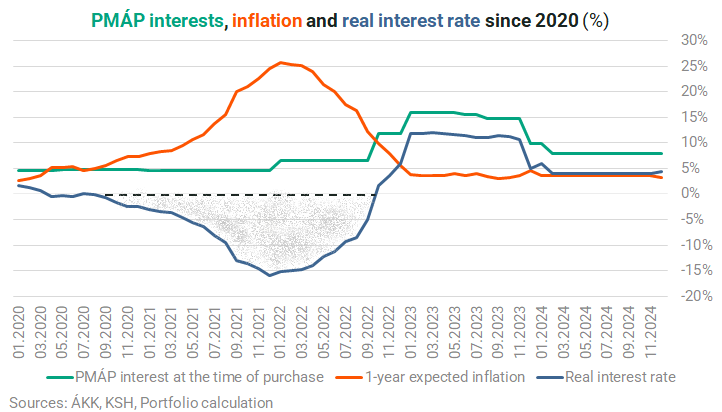
To see exactly how delayed the Government Debt Management Agency's (ÁKK) reaction to inflation is through the PMÁP, we looked at the interest rates of the PMÁPs available to the public from the beginning of 2020 (always based on the highest monthly interest rate) and compared this with the inflation rate over the following year.
Az alábbi gyűjtésünk alapján elmondható, hogy 2020 elején kezdett el folyamatosan apadni a PMÁP-okhoz kapcsolódó reálkamat, az egyre emelkedő, egy év múlvai éves infláció és a viszonylag alacsony szinten ragadó PMÁP-kamatok együttese végül
2020 áprilisától átcsapott egy negatív reálkamatos időszakba, amely két és fél évig tartott. A negatív reálkamat mértéke 10 hónapon keresztül 10%-nál is nagyobb volt.
Based on our collection below, the real interest rate associated with the PMÁPs started to decline steadily in early 2020, and the combination of rising annual inflation after one year and relatively low PMÁP interest rates finally turned into a period of negative real interest rates from April 2020 onwards, which lasted for two and a half years. The negative real interest rate was more than 10% for 10 months.
The turning point came at the end of September 2022, when the ÁKK came out with the 11.75% PMÁPs, which in many ways were a watershed, as the backward-looking inflation rate was lower from October 2023. As a result of inflation, which had been falling steadily from high levels in the meantime, PMÁPs were once again able to offer investors a positive real interest rate.
In terms of PMÁPs, 2023 was the golden age of positive real interest rates, with a spike in PMÁP rates, but more so because of a sharp fall in inflation. Interest payments during this period allowed investors to enjoy real interest rates above 10%.
What could PMÁPs deliver in the future?
Although from the end of 2023 onwards, the PMÁPs fixed in the first interest rate period appeared (precisely to mitigate the impact of falling inflation and interest rate outflows), those who bought into these securities were not wrong, as with inflation expected by analysts to be around 3.7% in December this year,
the PMÁPs fixed in the first interest rate period also seem to have provided a positive real interest rate last year.
Moreover, if analysts' estimates of inflation in December 2025 are correct, these PMÁPs, fixed at 9.9% and 7.9% for the first period, could still provide a positive real interest rate this year, despite the fact that their interest rate will fall to 4.2% after the April payment.
Of course, there are many "ifs". With analysts surveyed by Portfolio expecting inflation to average around 4% this year (and 3.7% only by the end of December), it is possible that some months will see higher inflation, which could easily push back the positive real interest rate.
- On the one hand, there are the PMÁP investors who, although affected by inflation above 4% during the year, typically pocket higher interest rates over the previous 12 months, so are less threatened by falling real interest rates due to rising inflation.
- On the other hand, for those who will be buying from the 4.2% PMÁP now or from April (if current conditions remain), it will not be the inflation this year that will be of interest, but where inflation will be in the spring or summer of 2026.

As the majority of investors have savings in previously issued PMÁPs, with interest rates falling back to between 3.95% and 5.2% this year,
it is mainly those with a negative or zero real interest rate premium of around 0.25%-0.5% who could face a negative or zero real interest rate this year. The risk of a negative real interest rate is therefore mainly for PMÁPs maturing in 2028, 2032 and 2033
(these are the securities that started selling in 2023 and 2024).

The big question is under what conditions will PMÁPs be available for purchase this year (the sale of the current PMÁP, which has a fixed interest rate of 7.9% in the first period, closes on 7 February and the interest rate will fall to 4.2% from 22 April). We have already seen that in the context of falling inflation, the ÁKK has made the new series of PMÁPs low fixed rate for the first year (fixed at 9.9% and 7.9% respectively), but unless there is a big jump in inflation this year, it is not expected that the PMÁP rate will be raised, pointing to the positive real interest rate as described above.
A good reference for the debt manager's inaction could therefore be the fact that, on the one hand, most of the securities are currently offering positive real interest rates and, on the other hand, the ÁKK has already responded to rising inflation with the Fix Hungarian Government Securities (FixMÁP) and MÁP Plus rates, which have not been cut further since October last year, meaning that both papers are paying higher interest rates than the PMÁP rate determined by last year's inflation. These other retail government securities are therefore expected to continue to provide positive real yields this year.
However, plans could be significantly altered by an unexpected event, such as much larger than expected outflows and redemptions from PMÁPs, which Portfolio's research suggests may even be expected. From a debt management point of view, this could even translate into a temporary but more attractive than expected government securities response. Will there be a premium government security that tracks inflation more flexibly and quickly? Not likely. But there could be additional interest rate powder in the ÁKK's pocket, should it be needed.
Cover photo (for illustration purposes only): Getty Images