Shareholders approve massive dividend payout at Hungary's Mol


Zsolt Hernádi, Chairman-CEO of Mol, opened the company's Annual General Meeting with a review of the company's performance in 2024 and its outlook for the future. According to the CEO, the company has achieved significant success in several business areas despite the challenging economic conditions.
Regarding the performance of business segments, Hernádi highlighted increased production and successful drilling operations in Hungary and Pakistan in the Exploration & Production (upstream) sector. In Refining & Marketing (downstream) operations, Mol maintained stable supply and progressed with its transformation strategy. The EUR 1.3 billion polyol complex was completed in May 2024, and the region's largest green hydrogen plant was launched in Százhalombatta in September. In Consumer Services, they successfully completed Polish and Slovenian acquisitions, expanding their network to nearly 2,400 filling stations.
The CEO particularly emphasised developments in waste management, noting the success of the previously contested mandatory Deposit Refund System (DRS) in Hungary. He announced that
Mol will invest HUF 500 billion in waste management over the next decade.
Addressing the operating environment, Hernádi discussed government levies, pointing out that the group had paid nearly USD 3.5 billion in extra taxes to various government budgets over the past three years, which he said undermines competitiveness.
This is becoming too much, we need to exit this situation,
he stated.
The CEO stressed the importance of improving competitiveness, calling for more predictable domestic regulations, addressing labour shortages, and developing infrastructure.
He emphasised that as one of the EU's most export-oriented countries, Hungary needs to "win international matches" to grow. He noted that current trends are concerning, partly due to external factors such as US trade policies, poorly thought-out EU green initiatives, and particularly the weakness of the German economy.
We need to find new partners who are independent of European economic policy. We need new economic relations, we need to rethink the system of economic cooperation in Central Europe.
Turning to domestic reasons, Hernádi stressed that
more predictable regulation is needed to improve domestic competitiveness,
as rapidly changing regulation has serious financial implications, which in turn discourages investment.
Highlighting uncertainty and the need to prepare for the new normal, he said:
Uncertainty is the greatest enemy of business.
Shareholders approved a dividend of HUF 220.4 billion,
including both regular and special dividends, totalling HUF 275 per share. At current share prices, this represents a dividend yield of 9.4%.

Commenting on the current dividend payment, Zsolt Hernádi told the meeting:
We do not see any exceptional acquisitions this year that would make the proposed dividend payment unsustainable.
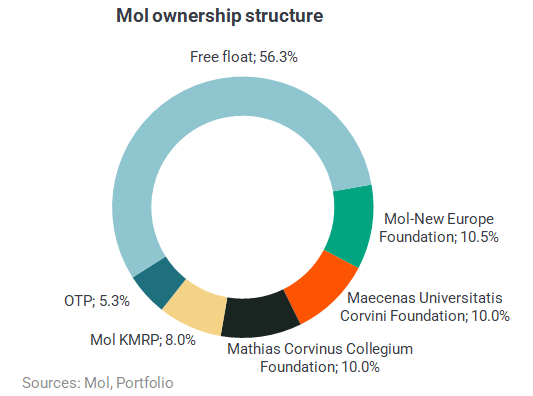
Of the total dividend, institutional investors and retail shareholders will receive over HUF 124 billion, while three foundations will collectively receive HUF 67.2 billion. OTP Bank will receive HUF 11.7 billion, and Mol employees will receive more than HUF 17.5 billion through the employee stock ownership programme.

Cover photo: Mol