Hungarians are saving in an interesting way, doing something like nobody else in Europe


Hungary's saving rate high up in EU ranking
In the last quarter of 2024, Hungarians saved 17.3% of their income, compared with a gross saving rate of 15.2% in the euro area, according to seasonally adjusted Eurostat data. The average of the last four quarters of unadjusted data shows an even greater Hungarian advantage: Hungarian households had an average saving rate of 18.1% in 2024, compared with 15.2% for the euro area over four quarters.
The gross saving rate is the ratio of household saving to gross disposable income over a given period. Gross disposable income includes all market (e.g. wages, salaries, entrepreneurial income) and government (e.g. pensions, social benefits) income of households after taxes and contributions, but excludes depreciation of assets. Household saving is the difference between gross disposable income and final consumption expenditure.
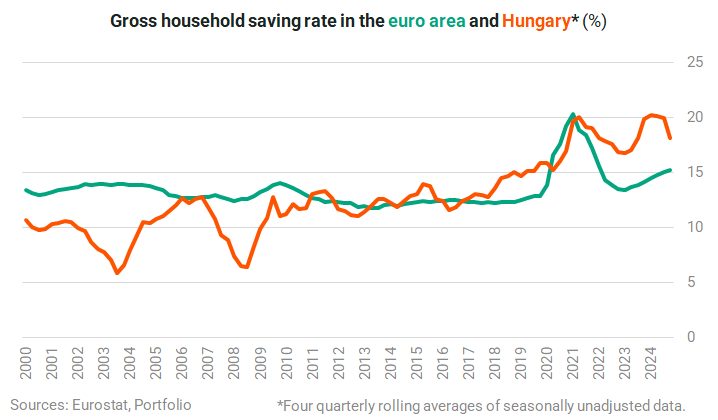
It can be seen that from 2000 to 2011, Hungarians underperformed euro area countries in terms of savings, except for a shorter period around 2006.From 2011, Hungarian and euro area savings rates were practically neck-and-neck, and from 2018 Hungary was ahead.
The euro area temporarily caught up with Hungary in the years affected by the Covid lockdowns, but thereafter the Hungarian savings rate stabilised at a much higher level, i.e. the consumption rate was lower - a factor known as the "cautionary motive" may be one explanation for this phenomenon.
The highest (seasonally adjusted) quarterly value was recorded in the last quarter of 2023 when hungarian households saved 24% of their income.
This was an EU record for the period. The Hungarian savings rate of 19.5% in the previous quarter was higher than that of any other country.
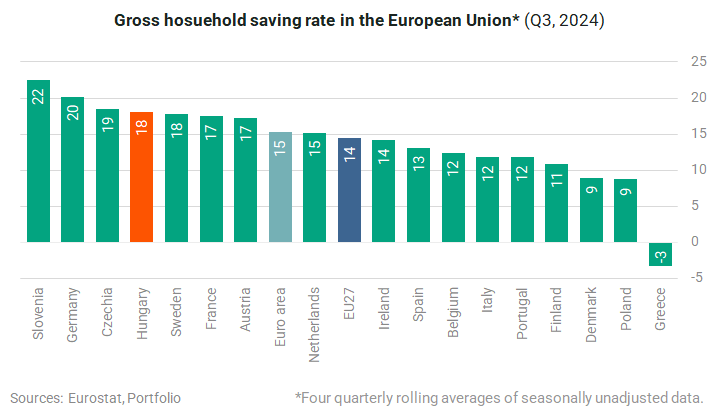
Based on the latest available data, the Hungarian population's propensity to save is relatively high compared to other EU countries. In the third quarter of 2024, only three countries — Slovenia, Germany, and the Czech Republic — had a higher proportion of income saved. At the other end of the scale were Denmark and Poland, which had single-digit saving rates, and Greece, which had a negative saving rate — meaning Greeks spent more than they earned. This kind of 'over-consumption' can be funded through borrowing or by depleting savings.
Hungarians' housing wealth has soared, but financial savings have also grown nicely
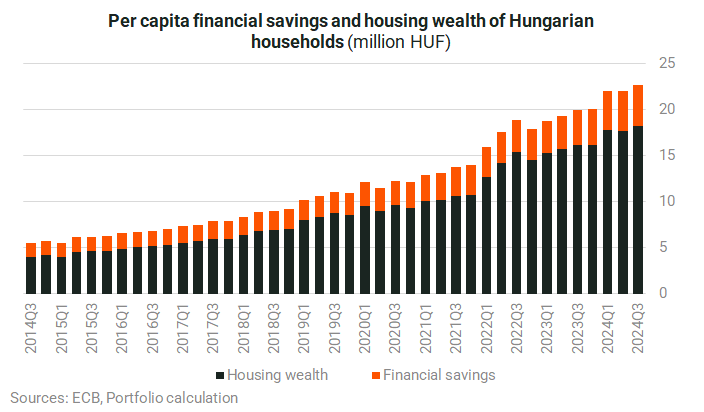
Despite all the adversities, the last ten years have seen a rapid growth in the financial savings and real estate assets of Hungarians. According to the European Central Bank, the per capita value of housing wealth increased to HUF 18.2 million from HUF 4.0 million between the end of September 2014 and the end of September 2024, while the total value of financial savings (including bank deposits, debt securities, investment funds, life insurance policies and stock market shares) increased to HUF 4.5 million from HUF 1.5 million. (Cash savings are not included in the ECB database.)
The total value of financial and non-financial assets held in savings averaged HUF 22.7 million per capita in September 2024, compared to HUF 5.5 million ten years earlier.
Therefore, per capita housing wealth has increased by an average of 16.4% per year over ten years, whereas financial savings in a narrow sense have grown by 11.7% per year over the same period.
Importantly, the increase in housing wealth was not primarily driven by the renewal of the housing stock, but by general property market appreciation. Eurostat data show that Hungarian house prices more than tripled (by 234%) between 2010 and 2024. While this is undoubtedly negative for buyers, it has led to a significant increase in wealth for existing property owners.
Of course, wealth is distributed unevenly within a country's population. According to data by the National Bank of Hungary (MNB), the richest tenth of Hungarian households held more than half of the country's total net wealth at the end of 2020.
Although wealth in euro area countries started from a much higher level than in Hungary, it grew at a slower pace, bringing Hungarians somewhat closer to Western countries in this respect. In the third quarter of 2014, the per capita housing wealth of the euro area population amounted to HUF 23.0 million, while financial savings amounted to HUF 11.5 million.
This means that a euro area resident started with assets worth HUF 34.6 million, which was 6.3 times the average in Hungary. It is important to note that this comparison is in nominal terms only and does not take into account differences in price levels (i.e. purchasing power parity).
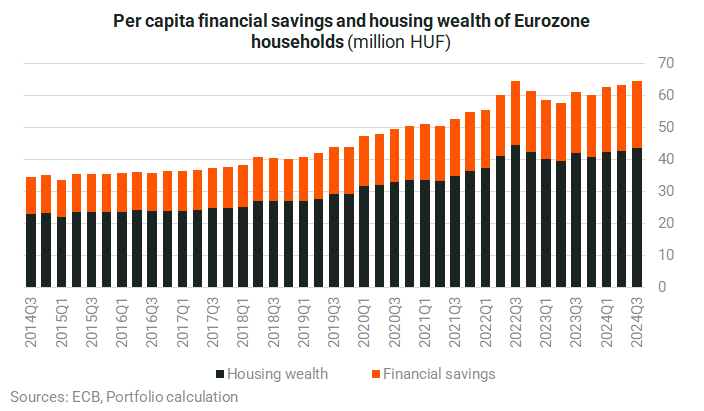
Ten years later, by the third quarter of 2024, per capita housing wealth in the euro area was HUF 64.5 million (an annual average increase of 6.4%), and per capita financial savings had grown by an average of 6.2% per year over ten years to HUF 21.5 million. Therefore, total wealth per capita was HUF 64.5 million, 2.8 times higher than in Hungary over the same period.
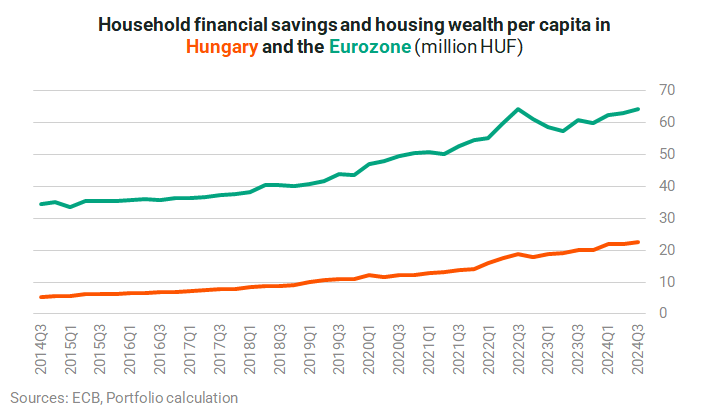
Hungarian households hold a significant proportion of their assets in forints, whereas euro-area countries predominantly hold assets in euros. Consequently, fluctuations in the EUR/HUF exchange rate can cause a substantial shift in the value of Eurozone savings in forint terms, even if there has not been a significant change in euro terms, as was evident at the end of 2022.
Hungarians unbeatable in debt security savings
Digging deeper into the savings data reveals some interesting facts. For instance, the way Hungarians distribute their wealth across asset classes differs greatly from that of the approximately 350 million people living in the euro area.
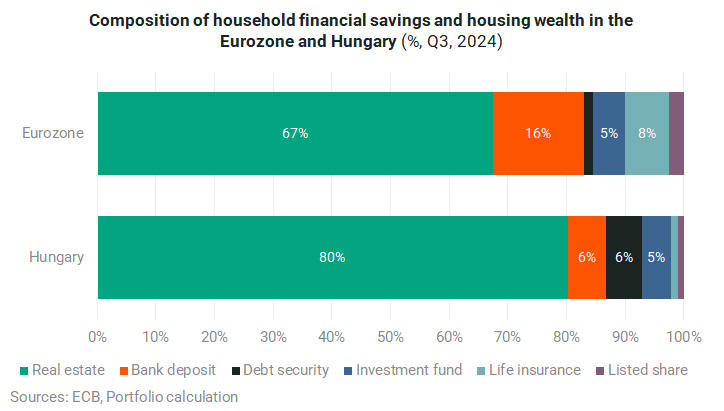
In the Eurozone, two-thirds of savings are in real estate, followed by bank deposits at 16%, with investment life insurance making up the third largest category at 8%. Western Europeans hold 5% in investment funds, 2% in listed shares, and 1% in debt securities.
By contrast, Hungary is characterised by a much higher concentration of housing wealth savings, with 80% of household wealth tied up in real estate. Bank deposits are the second largest asset, accounting for 6% of household savings, while debt securities are the third largest, with Hungarian households holding 6% of their assets in this form, predominantly in government securities. Hungarians invest 5% of their assets in investment funds, while life insurance and stock market shares usually account for 1-1%.
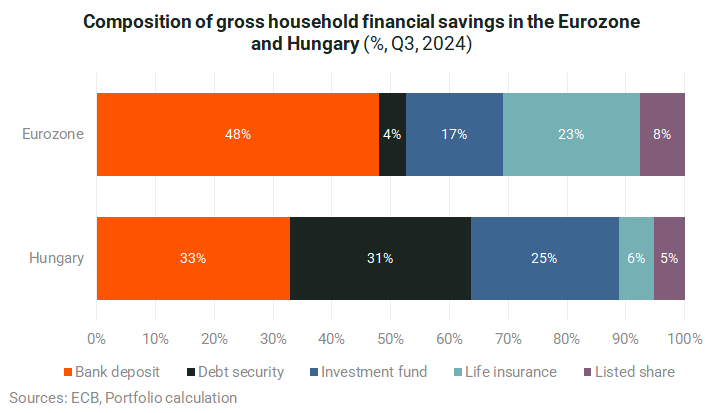
If we exclude housing wealth from the equation and focus only on financial savings, the specific savings strategy of Hungarians becomes even clearer. In the euro area, nearly half (48%) of the savings tracked by the ECB are held in bank deposits. In Hungary, however, the proportion held in bank deposits is around one third (33%).
The most striking difference is in the debt securities category. While Hungarians hold 31% of their savings in these instruments,
savers in the euro area invest only 4%. Households have a similar level of exposure to mutual funds and quoted shares. However, Western Europeans (23%) have much higher exposure to life insurance than Hungarians (6%).
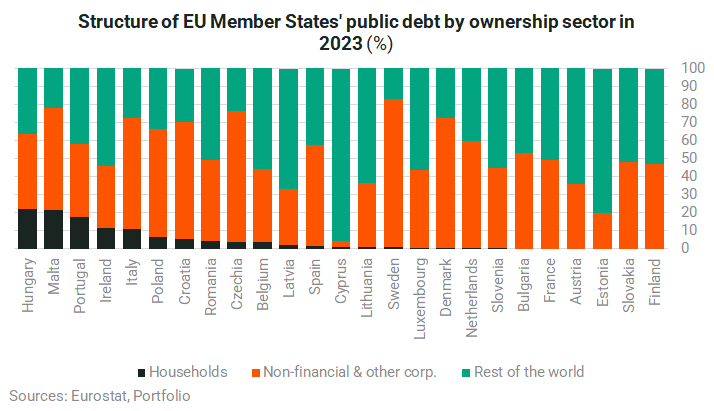
Hungarians' extremely high exposure to debt securities can be explained by their significant participation in the government securities market. According to data from 2023, Hungarian households held 21.9% of Hungarian government debt — a record in the European Union.
Households in Malta were the second largest contributor to public debt financing (21.7%). However, in most other EU countries, public debt is typically financed by financial and non-financial corporations and foreign investors. Germany and Greece are excluded due to a lack of data.
Cover image (for illustration purposes only): Getty Images