Hungary divided in two, only a narrow group of people could really get rich


Hungary has come closer to the EU average
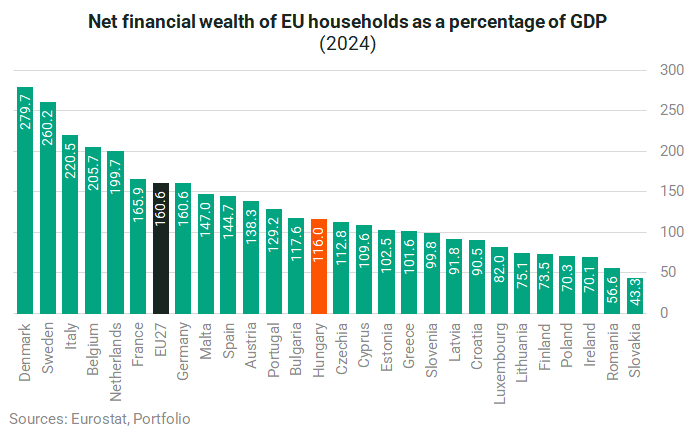
According to Eurostat data, the net financial wealth of Hungarian households, i.e. the difference between financial savings and liabilities, will amount to 116% of GDP in 2024. This puts Hungary in 13th place in the EU ranking, with only Bulgaria among the Central and Eastern European countries achieving a better result.
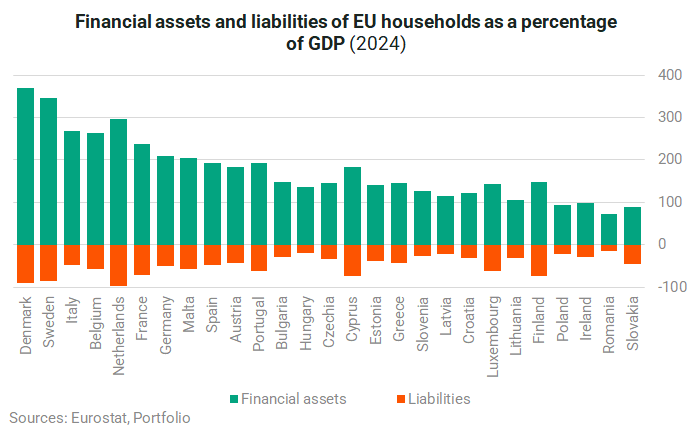
The high ranking among the regional countries is mainly due to the low indebtedness of Hungarian households. In terms of financial assets (wealth), Hungary ranks only 20th, with the Czech Republic and Estonia, among others, ranking higher. At the same time, Hungarians have very little debt, with the second lowest level of liabilities (debt) as a share of GDP.
In fact, the Hungarian population has the lowest relative indebtedness, i.e. the liabilities to financial assets,
with only 15% of financial assets in Hungary, while the EU average is over 25%.
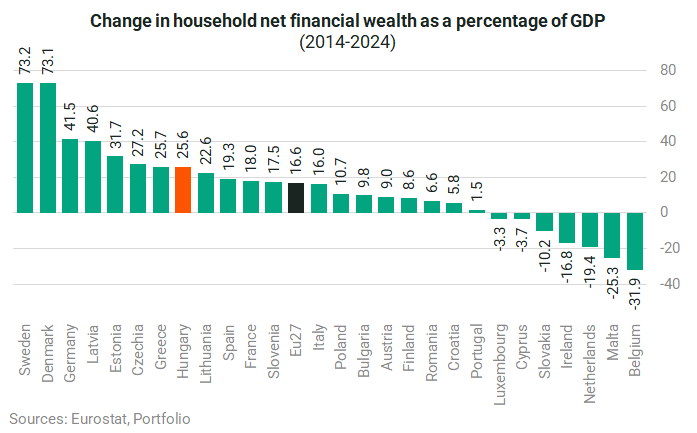
Between 2014 and 2024, data show strong wealth growth in Hungary, with the net financial wealth of the population as a share of GDP increasing by 25.6 percentage points over ten years, the 8th best performance in the field. It is true that Hungarians started from a lower base than the average, with net financial wealth of only 90.4% of GDP in 2014, while the average net financial wealth of the European Union was already 144% of GDP, from which base the European Community has seen an average increase of 16.6 percentage points.
The Hungarian outperformance was mainly due to the above-average pace of accumulation of financial assets. The EU and Hungarian populations have built up their debt-to-GDP ratios by the same amount (10 percentage points), but the Hungarians have increased their financial assets by 14% of GDP, while the EU has increased its by only 6% of GDP.
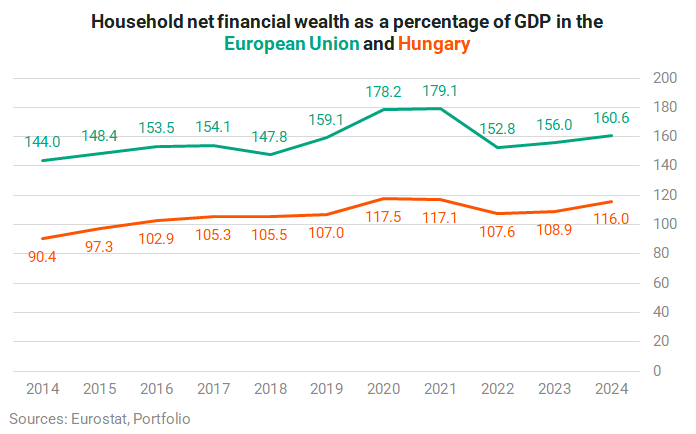
As a result of faster-than-average wealth growth, the Hungarian population has moved closer to the EU wealth level: while in 2014 Hungary reached less than 63% of the EU average, by 2024 it had reached over 72% of net financial wealth as a share of GDP. Importantly, meanwhile, Hungarian GDP per capita has also converged with the EU average, rising from 69% to 77%.
The top tenth pocketed the wealth increase
In addition to the figures describing the situation of the country as a whole, it is also worth looking at how the situation of different wealth strata has changed over the past ten years. It is natural that wealth is not evenly distributed within a country, but the degree of inequality varies. The European Central Bank ranks and deciles a country's households by net wealth calculated by subtracting the household's wealth from its debts.
Detailed data can be used to determine the share of each wealth stratum in the narrowly defined household savings in the country (the statistics include bank deposits, bonds, shares, mutual funds and life insurance reserves as savings, but exclude cash, pension fund reserves and OTC company shares.)
It is striking that the top tier in Hungary has an exceptionally high share of the country's savings:
the richest tenth of households hold almost 70% of savings, the third highest share among the countries in the compilation.
Only in Croatia and Lithuania is there a higher concentration of wealth, with the top decile holding almost 80% of savings.
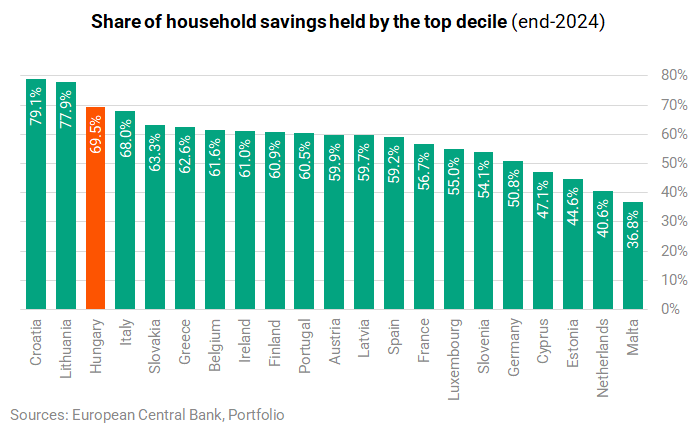
At the beginning of the period under review, in 2014, the share of the Hungarian top decile was much lower, holding 65% of savings, meaning that wealth concentration has increased significantly in ten years. The wealth of the country has therefore mainly benefited the wealthier:
72% of the increase in financial savings has been concentrated in the pockets of the top decile,
so the share of the bottom decile in the country's savings has even decreased.
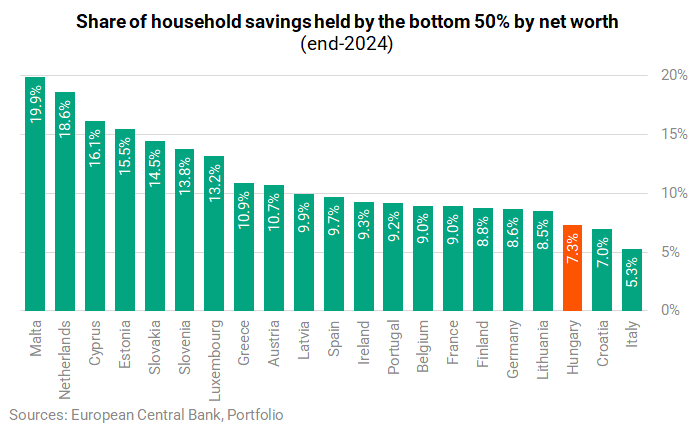
Meanwhile, the bottom 50% of Hungarian households by net worth have an extremely small share, holding only 7.3% of the country's savings, the third lowest. Their share declined from 2014 to 2024, at the beginning of the period they still held over 10.1% of savings.
A similar picture emerges for the wealth of the “middle class” between the top 10% and the bottom 50%, with 23.2% of savings, the fourth lowest of the countries shown. Tenths in the 6th to 9th percentiles have also lost ground, with a share of over 24.8% ten years earlier.
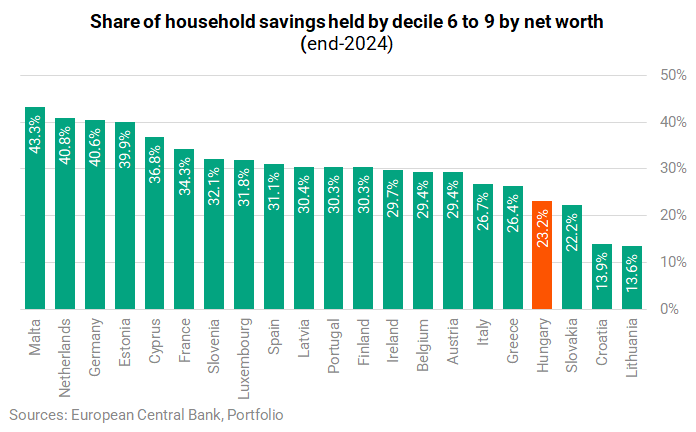
The figures also show that, at median values for the European countries surveyed, the top decile typically concentrates 60% of savings, the next four deciles account for around 30% and the bottom 50% of households receive 10%. This situation could be achieved in Hungary if the wealth of the top decile did not increase, while the middle layer increased its financial assets by one and a half times and the bottom layer by 60%.
Cover photo (for illustration purposes only): Getty Images