Orbán asks for immediate RRF credit, Brussels says not so fast


Faced not only with the increasingly negative economic consequences of the war in Ukraine, but also with an influx of refugees from the country ravaged by an invasion of Russian forces PM Orbán asked European Commission President Ursula von der Leyen in a letter last Friday for the “urgent approval” of Hungary’s Recovery and Resilience Plans, Partnership Agreements and operational programmes.
Hungary’s national plan for the Resilience and Recovery Facility (RRF) has not been approved by the Commission for the country has failed to remedy corruption issues and contested irregularities in public procurement tenders.
I ask the Commission to allow rapid, targeted and flexible use of EU budgetary resources by removing pre-financing, co-financing and transferability limits,
he said.
Additionally, he has also requested
the immediate provision of the allocated loan facility under the Recovery and Resilience Facility for defence, border control, as well as humanitarian and other acute crisis management tasks.
Hungary would have been entitled to around HUF 5.9 trillion from the EU recovery programme in the wake of the coronavirus crisis. In the spring of 2021, however, the cabinet unexpectedly waived the HUF 3.4 trillion loan (57% of the RRF) due to the constraints, and then in the autumn it chose to raise funds from the market at a higher price in a gigantic bond issue.
The government had said that it was only temporarily waiving the recovery loans, and there was a chance that once the full EU recovery envelope was finally allocated on the basis of the 2021 economic data, Hungary would request at least a part of the loan facility.
One of Portfolio’s sources in the European Commission said the PM’s letter is no grounds for action. There are clear rules what is requested for the EU executive to assess such pleas, including a detailed explanation as to why the member state wants additional resources and what it would spend these funds on.
This is exactly what Andrea Masini, the Commission's spokesperson for economic affairs, told financial news portal Privátbankár that
the European Commission is still analysing the letter sent by Prime Minister Viktor Orbán to the Presidents of the Commission, the European Council and the European Parliament last Friday.
The spokesperson added that Hungary has not yet submitted a specific request for a credit line under the Recovery Fund in accordance with its rules. Andrea Masini also warned that the Hungarian government would have to justify the request and that
it needs to justify the need for more funding, further reforms and investments, for which milestones and targets need to be agreed.
Portfolio’s source underlined that the non-refundable financial support (grants) and credit legs of the RRF cannot be treated separately, i.e. Hungary will need to treat them as one and come up with a ‘grants+credit’ plan.
A source of Privátbanár also stressed "there is no precedent for a Member State to have just asked for credit, it would not even make sense. Loan and grant will be linked. They cannot be separated as far as the substance (reform proposals and investment) part of the package is concerned."
Another key issue is Hungary’s debt-to-GDP ratio which the government wants to and has to lower from one year to another. (It managed to achieve only a tiny reduction last year.) Meanwhile, the cabinet is also adamant that the 4.9% of GDP budget deficit target (revised downwardly) will be achieved.
The negatives of the RRF credit line are that it would boost the debt-to-GDP ratio, and it would come with a long of strings attached. On the positive side, there’s the EU’s AAA credit rating which allows it to tap markets for funds at practically 0% interest, while – needless to say – Hungary would be able to raise funds at much higher interests.
Our conclusion is that the government is likely to request just as much credit as it needs for financing purposes and that does not jeopardise the reduction of the debt ratio, which is watched closely by investors, especially during the Russia-Ukraine war.
In the meantime, it is in the government's best interest to obtain the EU funds for the new cycle as soon as possible. On the one hand, it would want to have the revised recovery programme and the operational programmes for 2021-2027 adopted as soon as possible, and then it would want to draw money from them as soon as possible, even with the rule of law procedure hanging in the air.
This would also serve to maintain the state's investment activity (without indebtedness) and provide the central bank with a source of foreign exchange at a time when the economy is in a visibly difficult situation.
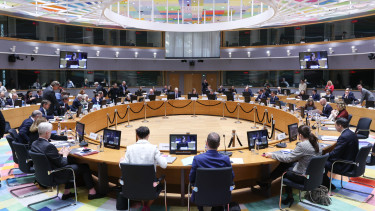
Cover photo: European Union, Etienne Ansotte, European Commission media library