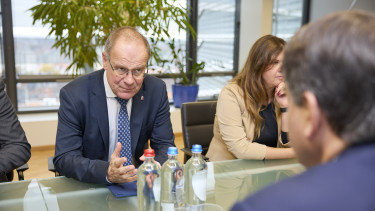
Council President Charles Michel meets Hungarian PM Viktor Orbán in Budapest


Bertalan Havasi recalled that the meeting took place in the framework of the preparation of the EU summit in December, and was attended by János Bóka, Minister for EU Affairs.
Today's meeting was revealed last Friday, and it fits in with the key discussions ahead of the EU summit on 14-15 December. The trigger was that Orbán wrote a letter to Charles Michel calling for a strategic discussion on Ukraine at the forthcoming EU summit, and only on this basis should the EU commit to supporting Ukraine financially (€50 billion package over 4 years, in parallel with the mid-term review of the 7-year EU budget) and to opening accession negotiations. Orbán has already indicated on several occasions that in absence of such a strategic deal he is ready to opt for a veto, which would represent a serious loss of political prestige for the EU's Ukraine strategy. Charles Michel has travelled to Budapest to address these tensions.
Hungarian opposition to additional EU budget spending is also fuelled by the fact that the Hungarian government does not yet have access to the 2021-2027 budget because of the rule of law disputes, as the €22 billion of cohesion funding is still blocked by horizontal enabling conditions. In this case, the government has to answer two questions regarding a recent judicial reform, for the Commission to unblock €13 billion of funds. Recovery funds are also blocked until 27 super-milestones are met. A decision by the European Commission last week to approve the revised recovery and resilience plan (RRP) will open the way for pre-payments around February.
The mid-term review of the 2021-2027 multiannual financial framework (MFF) and the decision on the Ukraine aid programme are highly questionable to be taken at the EU summit this December, partly because of opposition from the Frugal Four (Austria, Denmark, the Netherlands, Sweden) that do not want to pay more money, and partly because of a German Constitutional Court ruling. The latter is due to the fact that the German government will have to find a way to plug a €60 billion financial hole in the coming years.
In response to the tensions over the MFF review, Spain last Thursday proposed three cuts of different proportions to the Commission’s current budget that would save, respectively €5 billion, €10 billion and €20 billion, according to a document seen by Politico. But much to the disappointment of the frugals, the Spanish plan excluded cuts to the EU’s agriculture program and cohesion funding — two major chunks of its budget.
Not surprisingly, both the frugal and the spendthrift member countries criticized the proposal. Capitals on both sides of the divide are flexing their muscles as the clock ticks. Countries need to strike a deal before next March to continue funneling aid to Ukraine — which risks going bankrupt without the extra EU cash.
According to the frugals, the Spanish proposal does not go far enough. “[The Commission and Presidency] now exclude 2/3 of the budget a priori by saying that cohesion funds and CAP are untouchable,” said an EU diplomat. “If we really need to save money, we can’t exclude 2/3 of the MFF budget from the scope.”
The MFF review can be extended until next March, it doesn't have to happen now at all costs, and the Ukraine aid programme can be taken out of the MFF, so it doesn't need unanimous decision making and the Hungarian veto can be avoided.
This can be achieved by putting together the Ukraine programme on an intergovernmental basis, with enhanced cooperation. But this may not have the best perception and from a longer-term strategic perspective it may not be the right way to commit to supporting Ukraine without the support of one (or at most a few) Member States. These questions were certainly raised at this morning's meeting between Orbán and Michel.
Cover photo: Dario Pignatelli, European Union