Hungarian gov't continues to lose EU funds, with little room left for tenders


In June 2024, Hungary was heavily fined by the Court of Justice of the European Union (CJEU) for breaching asylum rules. According to the ruling, the country failed to ensure that asylum seekers' rights were properly enforced and unlawfully prevented asylum applications.
The Hungarian government's position is that the ruling is politically motivated and unjust, so it is taking legal action rather than changing domestic law.
Although the Cabinet says the penalty is imposed for refusing compulsory admission, this is not actually required by the European Commission and the CJEU. Under the rulings, the government should only allow asylum procedures to be initiated within the country, which the authorities still have the power to refuse.
The sanction also imposes a significant financial burden on the country: Hungary would have had to pay a lump sum of €200 million, plus a penalty of €1 million a day until it complies with the court's ruling and changes its domestic legislation.
As the government has not paid the amount, the fine is accumulating and every 90 days the European Commission will start to enforce the amount.
The European Commission has indicated that it may deduct the amount of the fine from the allocation of any EU funds, including agricultural funds and cohesion transfers for the time periods 2014-2020 and 2021-2027.
Information requested from Brussels
However, the Brussels executive has so far not answered questions about the source pools where the fines were collected, so Portfolio has requested information through a public interest request.
The European Commission said it had so far deducted three months of daily fines totalling €293 million (HUF 120 billion), in addition to the lump sum of €200 million, and that
deductions had been made for transfers of cohesion funds for 2021-2027.
The EU body also said that interest on arrears, which under EU law is a charge of 8% above the ECB base rate, has also been eliminated. Since October. they started at 3.5%, this meant a total of 11.5% penalty interest at the time of deduction, according to our calculations.
In total, the Commission was entitled to deduct around €325 million (HUF 131.5 billion).
And now, the daily fines, including those already collected, total more than €250 million. This means that some of the cohesion funds have been used to cover fines for breaches of EU law, rather than for Hungary's development.
Prime Minister Viktor Orbán has said on several occasions that the Hungarian government is not prepared to make any concessions to the European Commission in the migration debate. If the cabinet maintains this commitment, €365 million plus the ECB's current base rate and the 8% penalty rate could be deducted by Brussels this year. Calculated at current FRA rates, that means an average penalty of around 10.65%, meaning the Hungarian budget could lose more than €403 million in resources by the end of December. But here, depending on the transfers from which the Commission can deduct the enforcement, it is possible that agricultural funds will be hit by the penalty.
However, the n+2 rule means that, if the rule of law disputes are not resolved by 2025, another €1.04 billion in cohesion funding will become permanently unavailable.
Hardly any leeway left to launch tenders
This is also an increasing loss for the Hungarian budget, as the Hungarian government lost more than €1 billion of the total €21.7 billion cohesion budget at the end of last year, as it has been unable to reach an agreement with the Commission on the conditionality - colloquially known as the rule of law - procedure since 2022.
So, under the new n+2 rule for the common budget, it has lost nearly a seventh of the €10.5 billion frozen for the cycle.
In any case, Hungary's room for manoeuvre on EU funding is tight: the government can hardly announce new EU funding without a secure backing. According to the government website tender.gov.hu, only minimal funding is available for the 2021-2027 EU budget cycle, as frozen and deducted amounts have significantly reduced the available budget, while most of the €12.2 billion of the available funds have already been covered by tenders.
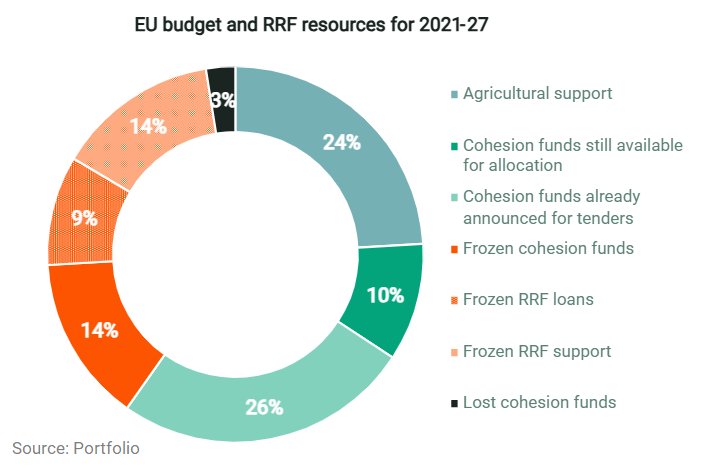
As things stand, the frozen cohesion funding accounts for the largest share, €9.6 billion, with a further €1 billion in N+2 deductions, while €6 billion of the Recovery and Resilience Facility (RRF) is also under freeze.
If we look at the money available and unavailable (apart from land-based agricultural subsidies), the situation looks like this:
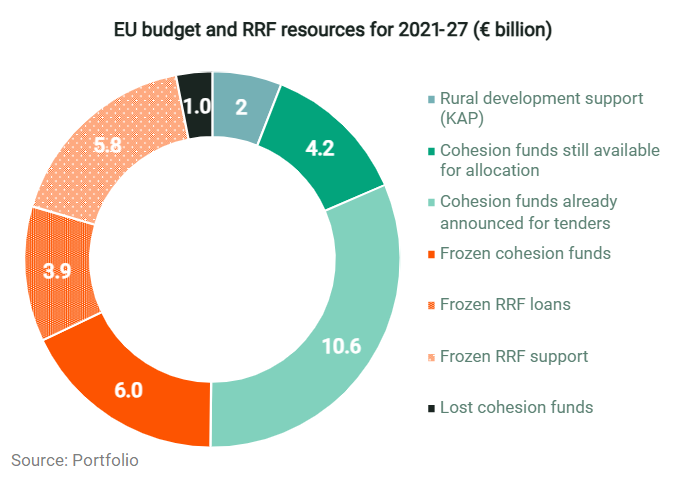
On paper, the government can commit to these by keeping them frozen by the European Commission, but this risks not being reimbursed by Brussels until the end of the 2027 budget cycle. And if this were to happen, EU budget deficit rules would mean that these items would increase the budget deficit for that year up to the total uncovered amount.
However, the deduction of the migration fine will also have cash-flow implications in the short term: the amounts to be enforced would represent the value of invoices already received, and therefore already paid or committed by the government to pay the winners of the various operational programme tenders. So each deduction reduces, if not drastically, the government's "cash holdings".
Cover photo (for illustration purposes only): Getty Images
With funding from the European Union. The opinions and statements expressed herein are those of the author(s) and do not necessarily reflect the official position of the European Union or the European Commission. Neither the European Union nor the European Commission can be held responsible for them.





