Hungary alone blocks EU declaration in support of Ukraine


European Union leaders adopted joint conclusions on Ukraine with 26 member states, after Hungary refused to vote in favour of the text.
The document talks about "peace through strength", military assistance and security guarantees, which Prime Minister Viktor Orbán has opposed because he believes they run counter to President Donald Trump's foreign policy. As is known, the US president is so far unwilling to offer security guarantees to Ukraine, instead offering a raw materials agreement, the proceeds of which would finance the post-war reconstruction of the country.
Washington has recently suspended US military assistance and intelligence cooperation. Last Sunday in London, the majority of EU member states, plus the UK, Canada and Türkiye, decided to jointly assure Ukraine of their support, a symbolic element of the final declaration of the EU summit.
The Hungarian government believes that the reduction in US aid will create a new situation for Europe. "As the United States cuts back its aid to Ukraine, Europe will have to decide whether it wants to finance the war on its own," government spokesman Zoltán Kovács wrote on X [formerly Twitter].
— Zoltan (Kovacs) March 6, 2025
According to Viktor Orbán, the majority of EU leaders have decided not only to continue supporting Ukraine, but also to take on the costs that Washington has previously covered.
The usual solution in the absence of consensus in the EU was finally chosen: a declaration of support for Ukraine issued on behalf of the 26 Member States and the President of the European Council, as well as the High Representative for Foreign Affairs, Kaja Kallas.
What finally made it into the text?
The text, which Hungary ultimately did not vote for, differs in only a few points from the text of the Council's previous final declarations on Ukraine. According to the text, the 26 supporting member states clearly expressed the European Union's continued firm support for Ukraine against Russian aggression.
As usual, the EU text stresses that
supporters stand by Ukraine's independence and that the country's sovereignty and territorial integrity are non-negotiable.
The European Council underlined that any peace negotiations should only be conducted with Ukraine's involvement and taking into account European security interests.
The current text is tougher in the sense that it says that
the way to negotiate an end to the war is through strength. As part of this, Ukraine needs to strengthen its defence capabilities, while the EU and its member states step up military and financial support.
According to the text, new financial resources were also announced during the meeting: in 2025, the EU will provide Ukraine with a total of €30.6 billion, of which €12.5 billion will come from the Ukraine Facility and €18.1 billion from the profits from the Russian frozen assets.
Military assistance is also being stepped up: EU countries have pledged to speed up the supply of air defence systems, ammunition and missiles to Ukraine, and to support the training and equipping of the Ukrainian army. The European Council urges member states to accelerate the implementation of the G7-initiated defence assistance programme.
On the issue of future security guarantees, the EU and its Member States are ready to make further commitments, including the possible use of the EU's Common Security and Defence Policy instruments. The European Council reiterated Ukraine's right to choose its own future, including the path towards EU membership.
They'll come back to the negotiations, there's unity in some cases
The text concludes that the next European Council summit will return to the issue of support for Ukraine and is expected to decide on further steps.
The Council's final declaration would not have set out concrete steps to be taken, aid to be disbursed immediately to help Kyiv, nor would there have been a binding detail on the peace negotiations. It is therefore an acceptable compromise for the other member states, as the joint resolution does not set any expectations.
Although Hungary did not support the joint resolution on Ukraine, there was agreement on defence policy.
All 27 Member States have approved plans to strengthen the EU's military capabilities, mobilising €800 billion over the next five years. This will launch one of the biggest defence investment programmes in the history of the European Union, with the aim of rearmament, joint procurement and enhanced military cooperation.
Earlier, it was not known whether Hungary would veto plans to step up defence cooperation, as it criticised the leaders of other countries after Europe's most powerful member states met in London. EU diplomats also feared - and several press reports raised the issue ahead of the extraordinary EU summit - that EU integration in the field of defence policy could also face opposition from the Hungarian government, but in the end Viktor Orbán - who also held talks with French President Emmanuel Macron on the issue on Wednesday evening - voted in favour of the joint moves.
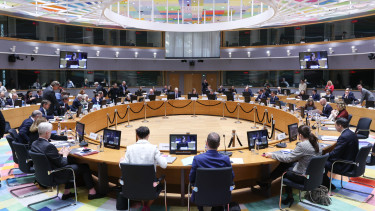
Cover photo (for illustration purposes only): EU