Overcrowded prisons, poor conditions - Hungary gets a tough call


The Committee of Ministers, recalled that six cases going back to 2010 concerns
inhuman and/or degrading treatment due to the applicants’ poor conditions of detention resulting mainly from a structural problem of overcrowding in prisons and the lack of effective preventive and compensatory remedies in this respect; as well as other detention-related violations.
The issue has been pending for more than 13 years, and the Committee has repeatedly urged the authorities
to adopt a comprehensive long-term strategy to resolve it.
It has also found that the measures taken to extend prison capacities
appear incapable of providing for a lasting solution to overcrowding.
They also highlighted nearly ten years after the pilot judgement (Varga and Others, 14097/12+) of the European Court of Human Rights, the authorities introduced a compensatory and a preventive remedy, which were subsequently abolished or revised, therefore the authorities urgently need to take further measures to comply with their obligations under Article 46 of the Convention.
They recalled "with concern" that over four years after the abolishment of the Convention-compliant specific preventive remedy, and despite the Committee’s previous calls, no statistical data allowing for the assessment of the effectiveness of the remaining general preventive mechanism has been submitted.
They are also "deeply concerned" by the fact that the amended compensatory remedy remain without response, in particular that the remedy does not entitle detainees to claim compensation for poor material conditions of detention if the statutory minimum of living space is ensured.
The Committee of Ministers reiterated its call on the authorities
totake additional measures, embedded in a coherent and overarching penal policy, to maintain numbers within prison capacity so as to resolve sustainably and for the long-term the problem of overcrowding.
They noted with regret the lack of any measures adopted with the aim of increasing the use of alternatives to detention, and urged the authorities to step up their efforts in this respect, including through the adoption of adequate guidance and training with the aim of ensuring a unified approach to the authorisation of such alternatives.
They strongly urged the authorities to enhance their efforts in improving material conditions and to provide concrete information on the measures taken or envisaged in this respect.
The Committee exhorted the authorities to either reintroduce a specific preventive remedy, or to track the complaints made in the general preventive mechanism and submit comprehensive case-law and statistical data in this respect, and also, once again, invited them
to consider the reintroduction of judicial review in respect of preventive complaints concerning prison overcrowding and unsuitable conditions of detention.
On a positive note the Committee noted with satisfaction the steps taken regarding the development of accessible accommodation for detainees with disabilities in all regions; and with a view to the potential closure of this issue, invited the authorities to submit detailed information per prison establishment and per year,
- regarding the number of detainees requiring special accommodation,
- the number of accessible accommodations,
- any transfers or other measures in order to accommodate them,
- any complaints made with regard to such accommodation and the availability of specialised cells and staff, and
- the outcome of these complaints.
They strongly urged the authorities to submit information about the implementation in practice of the measures regarding detention in special security regimes and corresponding statistical data to allow an assessment of whether similar violations are being prevented.
They invited the authorities
to submit an updated action plan, including information on all outstanding issues, by 1 December 2025,
and decided to resume consideration of this group of cases at its Human Rights meeting in March 2026, strongly encouraging the authorities, in the meantime, to strengthen their dialogue with the Secretariat concerning this group of cases.
Number of prisoners in Europe
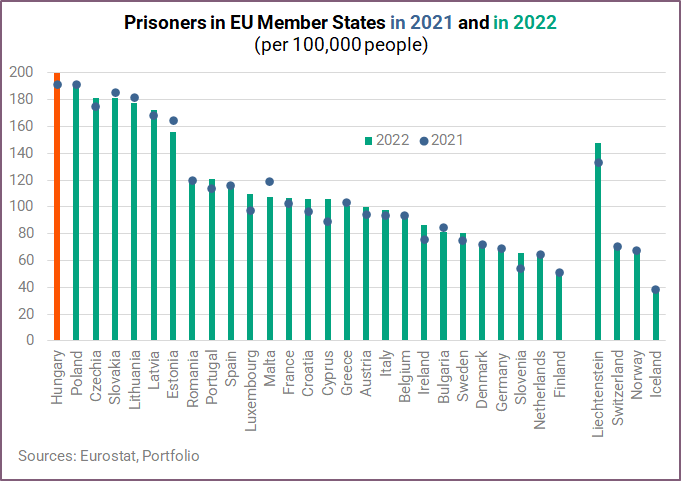
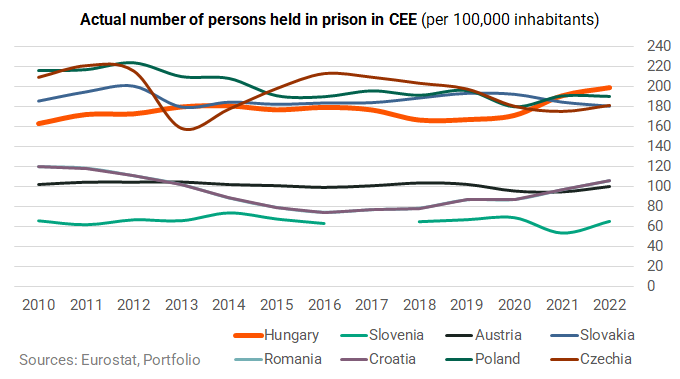
Hungary had the highest number of persons held in prison in the European Union in 2022 per 100,000 inhabitants (and also in 2021 for that matter), while it generally had the fourth highest number of prisoners since 2010 (bar two years in 2013 and 2014 when it was 3rd in this ranking).
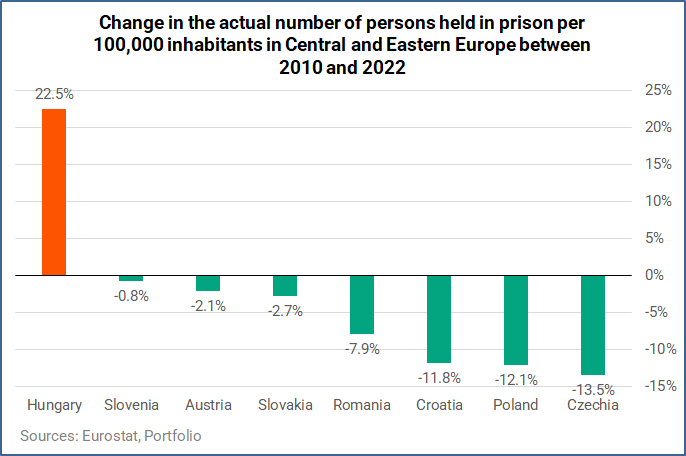
Looking at longer-term changes we find that Hungary stands out with an ascending trend, as the actual number of people in prison per 100,000 inhabitants has jumped by 22.5% between 2010 and 2022, while all other countries in the region saw a decrease over this period.
Overcrowded prisons
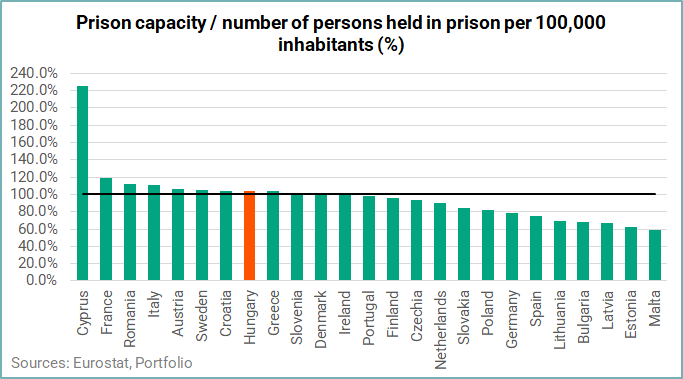
In 2022, ten EU countries experienced overcrowded prison cells, while 15 countries had extra capacity (data missing for Belgium and Luxembourg). The prison occupancy rate is the number of prisoners relative to the official capacity (design capacity) of prisons, multiplied by 100. Overcrowding occurs when the occupancy rate exceeds 100, indicating that there are more prisoners in the prison than it was designed to hold.
Overcrowding rates were observed in Cyprus (226), France (119), Romania (112.2), Italy (111), Austria (106.1), Sweden (105.7), Croatia (104.2), Hungary (103.5), Greece (103.4), and Slovenia (101.9).
The lowest prison occupancy rates were recorded in Malta (58.7), Estonia (62.2), and Latvia (67). In 14 out of the 25 EU countries that provided data in 2022, the prison occupancy rate increased compared with 2021.
Cover image (for illustration purposes only): Getty Images