EU divestment from Russian energy: Hungarian EU commissioner delays plans


The European Commission has come up with a special plan to deliver on one of the key promises of Ursula von der Leyen's second presidency: to wean the continent almost entirely off Russian energy. The EU has already taken several steps since 2022 to do something about reducing its dependence on gas and oil, but so far only partial results have been achieved.
By 2024, only 19% of fossil energy imports will come from Russia, but this is still a long way from complete or near complete divestment.
Energy Commissioner Dan Jørgensen is expected to present his plan at 3:30 pm on Tuesday, which would close the route for Russian energy supplies through market and trade regulations rather than the current sanctions route, EU officials told Portfolio.
To this end, it is important to see that while international restrictive measures require a consensus decision in the European Council, decisions on competition law and imports can be passed by qualified majority.
In a vote of the Member States, Hungary and Slovakia would certainly veto bans on Russian gas, while in a qualified majority decision they could be circumvented.
In the context of the sanctions debate, the Polish presidency has already suggested that a blocking of all restrictions by member states could be circumvented if the EU applied trade bans.
The agenda Jørgensen is now presenting would follow this same approach: a key element of the document he has drafted is that it would give private companies new legal options to terminate their Russian energy contracts, even for long-term contracts. In the latter case, the Commission is currently exploring legal options that would allow European companies to withdraw from Russian gas contracts on the grounds of force majeure - without penalty.
It would also encourage companies not to sign new agreements with Moscow.
According to information obtained by Reuters, the draft would see the European Commission gradually ban imports of Russian gas into the European Union. According to the details of the document, new Russian gas contracts and spot market purchases would be banned until the end of 2025. This legislative proposal is expected to be presented by the Commission in June 2025. In a second step, the Commission would also commit to ban imports of Russian natural gas and LNG under long-term contracts still in force by the end of 2027.
But the Commission's plan is not without political and economic obstacles. The plan was heralded as one of the first major priorities of President Ursula von der Leyen's second term, but its finalisation has been delayed by months, partly due to the re-election of President Donald Trump and a reassessment of US-Russian relations. Originally, the EU had hoped for a US LNG agreement to replace Russian gas supplies, but no such deal has yet been reached. In addition, the Commission's plan is still facing opposition:
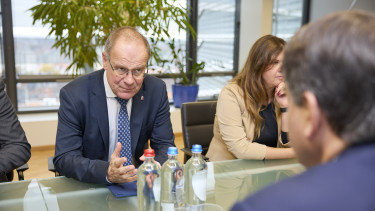
the Commissioner for Health and Food Safety, Olivér Várhelyi, has objected to the proposal, but this is not expected to prevent its adoption.
Politico reported on Monday evening about the objection to the College of Commissioners, after which the press speculated that Várhelyi might be in breach of the EU ban on representing the political interests of the sending member state. The Prime Minister who nominated him, Viktor Orbán, is vehemently opposed to restrictions on Russian energy supplies.
Now, in fact, the debate on EU competences will take place in the College of Commissioners. Várhelyi's complaint is procedural in nature. Essentially, it is a claim that the Commission's decision-making may infringe member state powers,
an EU official familiar with the case told Portfolio. Another diplomat clarified that, as far as they knew, the main issue was whether the executive was overstepping its powers by imposing restrictions on trade and competition.
Some have noted that without a sound legal argument, it would be political suicide to attack the plan: a commissioner who clearly defended the political position of their own country would be immediately asked to resign by Ursula von der Leyen. At the same time, they believe that it is “possible and necessary” to investigate whether the Commission is exceeding its own powers by a measure that indirectly interferes with energy sovereignty.
Between Trump and Putin
According to EU officials interviewed by our paper, the current procedural concern raises a number of questions that should be examined on their merits. However, none of them believe that the move will affect the presentation of the Jørgensen plan, which was postponed from the end of March to May. The decision would have to be taken in the Council, and the current presentation will have to go through several more rounds of negotiations at the level of ministers and then heads of government and state.
The European Commission's aim is also more of a long-term market signal - that Russia is no longer a reliable supplier - and that companies should not think about signing new contracts.
The problem is that many market players are already planning for a possible “disengagement”, as Russian energy prices are lower and more companies would be ready to re-establish relations after a possible Russian-Ukrainian peace agreement. The Commission is therefore trying to create a regulatory framework that will crowd out Russian energy in the longer term, even if the sanctions route is not viable.
The complexity of the legal environment and the state of the infrastructure also create uncertainty. According to Politico, the CEO of TotalEnergies says it's not inconceivable that pipelines from Siberia to Europe will be back online once the political climate changes. However, other industry players, such as the head of Italy's Eni, warn that business models have already adapted to the sanctions environment and Europe has significantly diversified its energy network.
The Italians say companies would be reluctant to fall back on a risky source that plunged the continent into an energy crisis in 2022.
The Commission's agenda is therefore more of a policy signal, a legislative reform proposal and a market stimulus package. The aim is to achieve long-term energy sovereignty, while finding alternative ways to move away from Russian energy due to the lack of consensus among Member States.
However, in Brussels, they expect to kill two birds with one stone: in addition to cutting off Russian energy sources, they would also send a message to US President Donald Trump. As mentioned above, in the tariff war, the EU is trying to meet Washington's request to buy more US oil and gas if tariffs are dropped. The current divestment agenda would thus also propose framework agreements with the US, for example, in the spirit of diversification.
According to EU officials interviewed by Portfolio, this would create an awkward situation for any member state seeking to curry favour with Donald Trump.
If you challenge the plans for divestment from Russia, you are also saying no to increased US imports, which paints a bull's-eye on you,
one diplomat told our paper.
The timing is no coincidence: the European Commission's Trade Commissioner, Sabine Weyand, is in the US capital today and tomorrow, 6-7 May, to meet a delegation of high-level technical experts to discuss the resolution of the tariff war.
This does not mean that the current plan will go through in its current form. Moscow has not taken kindly to the cancellation of long-term contracts: as we have reported, a series of arbitration cases have been brought against Gazprom when it has demanded payments for supplies in roubles. Although many companies have won damages against the Russians in legal forums for not paying for gas, Gazprom immediately cut them off from supplies. It is safe to assume that the same would happen now if some companies pulled out of long-term agreements.
The final form of the proposal could take many different forms, especially if Olivér Várhelyi's procedural objections are found to be justified.
Cover photo (for illustration purposes only): EU