Commission rips into Hungary's economic programme, urges painful measures


Economic growth was subdued in 2024. GDP grew by 0.5% in 2024 after a contraction of 0.8% in 2023. The sluggish GDP growth in 2024 was driven by weak external demand, a deterioration in business sentiment and lower investment, says the European Commission in its 2025 Country Report.
However, the outlook for this year and 2026 is more optimistic, but much more pessimistic than the government's official expectation of 2.5%:
GDP growth is forecast to reach 0.8% in 2025 and to pick up to 2.5% in 2026, driven by improving demand and new capacities in manufacturing, notably in the electric vehicle industry.
However, the EC says that Hungary’s economic outlook remains highly uncertain over the prospect of tariffs due to its high level of integration in global value chains.
It notes that inflation declined significantly from a peak of 17.0% in 2023 to 3.7% in 2024, as the impact of earlier energy and food price increases and supply chain bottlenecks dissipated. However, inflation excluding food, energy, alcohol and tobacco remained high at 5.9% in 2024, while inflation picked up in the first quarter of 2025.
Domestic demand and rising food prices are expected to keep inflation elevated in 2025.
Inflation expectations also remained high, partly because Hungary went through the highest consumer price increase in the EU.
Investment decreased from a high level by 7.7% and 11.1% in 2023 and 2024 respectively, the largest drop in the EU, while in 2024 the investment-to-GDP ratio was 23%. At the same time, Hungary registered the highest increase in construction prices in the EU.
"A combination of high construction costs and an uncertain economic environment for firms have contributed to the recent investment underperformance.
The decline in investment poses risks to medium-term growth perspectives,
the EC said.
A host of economic vulnerabilities
Hungary continues to face vulnerabilities, primarily over competitiveness and government financing needs. Policy action to tackle them has been limited, the EC said.
Hungary's public debt increased in 2024, with debt-servicing costs and gross financing needs remaining at high levels.
At the same time, the risk related to the high share of government bonds in banks’ total assets has deepened due to tax incentives for domestic banks in return for purchasing government debt.
This is a new element in the Commission's rhetoric, given that it has previously strongly recommended that Member States borrow from the domestic banking system rather than from external sources. However, there is now a strong risk of a feedback loop between the national executive and the banking system.
The Commission notes that
inflationary pressures have remained persistent, while rising labour costs have eroded cost competitiveness.
It adds that the economic recovery is slow and can be even slower as challenging external conditions and domestic policy uncertainty have continued to weigh on exports and investment.
The fourth vulnerability, according to the EC is that while the trade balance improved in 2024, policies aimed at boosting domestic demand and substantial energy imports pose risks on the sustainability of the country's financial position vis-a-vis other countries.
Finally, the in-depth review of Hungary highlighted that house prices accelerated in 2024. This was driven by strong demand, fuelled by easier financing conditions, generous housing policies and restricted supply.
The EC wans that some government interventions are distorting the functioning of the financial market.
"As a way to boost domestic demand, Hungary makes widespread use of poorly targeted subsidised loans to households and corporations, as well as administratively controlled mortgage rates. The proportion of subsidised loans remains high compared to the pre-COVID level. These schemes can lead to capital being allocated in a suboptimal way, by financing projects with low returns and limited productivity gains.
Such practices also limit the effectiveness of the central bank’s policy to control interest rates.
With debt forecasted to remain high, debt-servicing costs and risks over the sustainability of government finances are elevated, the Commission said. It added that "risks over the sustainability of government finances are low in the short term, but high in the medium term and medium in the long term, according to the Commission’s debt sustainability framework."
The EU executive believes that Hungary’s achievement of budgetary targets is at risk. In 2024, the government deficit decreased to 4.9% of GDP, from 6.7% the year before, on the back of temporary cuts in public investment, revenue from taxes levied on companies in the energy, financial and retail sectors, and lower energy subsidies.
However, in the absence of additional consolidation, the budgetary deficits are set to remain elevated, at 4.6% of GDP in 2025 and 4.7% in 2026,
according to the Commission 2025 Spring Forecast.
The 2026 budget law, submitted to Parliament on 6 May 2025, has revised the 2026 deficit target from 2.9% to 3.7% of GDP
On a positive note, the Commission highlights that net expenditure will rise significantly in 2025, though it will still be below the cumulative limit for 2024 and 2025 combined. The government is also adhering to its commitment to increase spending by only 4.2% more than in the previous year, as set out in the Excessive Deficit Procedure. The EC also warns, however, that
a realistic and stable medium-term budgetary framework would make Hungary’s fiscal policy more credible and effective.
The Commission once again mentions that the continued practice of adopting budgets early in the year (with one exception in 2024) and frequent revisions of the budgetary targets reduce reliability.
In turn, this limits policy predictability and proper accountability.
Just like in the previous years, the Commission criticises Hungary for the constant 'state of danger that has been in force since 2022 and extended repeatedly. This lifted the requirement to publish a three-year budget plan, and increased the discretion in implementing annual budgets.
Frequent changes to the annual budget law decrease predictability. Hungary‘s medium-term budgetary planning lacks multiannual spending ceilings that would make it easier for it to meet the requirements of the reformed EU economic governance framework.
Two spending reviews on healthcare and housing- and family-related support were conducted in 2023-2024, but these have not been published and are not reflected in the budgetary planning so far.
The mandate and operational capacities of the Hungarian Fiscal Council remain limited,
the Commission criticised.
Finally, the EC pointed out that budgetary oversight may be weakened further by new public fund management structures. In recent years,
Hungary has set up an increasing number of funds (public interest trusts, central bank foundations etc.) to carry out public duties such as education and research.
- These bodies received substantial public assets and/or annual funding from the budget.
- However, they seem to operate without effective oversight and control mechanisms.
- Board members are nominated without transparent and objective selection criteria and without any need to demonstrate asset management experience.
- Moreover, they have significant discretion in investment decisions.
As these funds are part of the general government sector, any management errors may impact government finances.
This has been a recurring theme in the European Commission's criticisms. The rule of law conditionality procedure addresses concerns about public interest trusts and conflicts of interest, as a condition for the release of frozen Hungarian EU funds and the country's re-inclusion in the Erasmus programme.
Hungary will be in deep trouble without structural reform
The European Commission is also calling for reform because an ageing population is putting long-term pressure on public finances, a situation that will only worsen without intervention.
Underpinning this, the EC notes that the ratio of potential workers per person aged 65 or older is projected to drop from 2.9 in 2023 to 1.8 by 2070. Population ageing means
Hungary’s public spending-to-GDP ratio for pensions is facing one of the largest increases in the EU, set to rise 4.3 pps between 2022 and 2070.
According to the Commission’s projections, Hungary’s public debt will also start to rise in a decade if ageing-related spending remains unaddressed. However, Hungary’s medium-term fiscal-structural plan states that the government does not plan any changes to the pension scheme in the near future.
Another serious criticism from the Commission is that labour productivity is one of the lowest in the EU and is at the same level as 15 years ago.
This is in contrast with EU countries with similar income levels, whose productivity increased by 10 pps during the same period. While the income level has increased steadily, this has been driven by a significant increase in employment rather than an increase in skills and productivity levels.
The significant increase in employment largely came from low-skilled people entering the jobs market, which impacted average productivity. Further impetus to growth would need to come from innovation and investment in high value added activities, also taking into account regions’ competitive advantages. However, future productivity growth may be held back by the weak quality of education, comparatively low levels of skills and lack of predictability in the business environment.
The EC also warns that a shortage of skilled labour continues to hamper growth prospects.
As a result of strong employment performances in recent years, the issue of labour and skills shortages is becoming ever more pressing. The education system is not producing enough highly skilled workers to meet growing demand on the jobs market.
Hungary’s tertiary education attainment rate has not improved in the last decade and is now one of the lowest in the EU.
Weak basic and digital skills among the disadvantaged and high early leaving from education limit employment prospects and skills development opportunities later in life. I
According to the Commission, the business environment remains a major barrier to innovation.
The EC also listed obstacles that surveys regularly highlight:
- unpredictable regulatory changes,
- an overwhelming presence of the State in domestic business transactions,
- hostility towards certain firms (foreign-owned in particular),
- limited government effectiveness,
- high perceived corruption and
- weak competition in key sectors.
As in previous decades, the EC notes that energy import dependence continues to weigh on the trade balance.
Net energy imports decreased from 4.7% of GDP in 2023 to 3.4% of GDP in 2024, mainly due to a decrease in oil and gas prices, rather than to diversification.
Net electricity imports as a percentage of domestic electricity supply also decreased, driven by increasing solar power generation. The national energy and climate plan sets a target to reduce the net import share of electricity to 20% by 2030; progress has been made towards this target.
Nevertheless, to minimise the country’s exposure to energy price shocks, more action is needed.
The EC highlights that high dependence on Russian fossil fuel poses a security-of-supply risk. As in previous decades, energy import dependence is noted once again as an economic handicap and a risk to fiscal balance, as it continues to impact the external balance.
Hungary continues to heavily rely on Russia for fossil fuels (in 2024 more than 70% of natural gas and more than 80% of crude oil consumed was of Russian origin) and for nuclear energy, although some steps have been taken to diversify supply.
Since Russia’s invasion of Ukraine, Hungary has strengthened its energy ties with Russia. In 2023 and 2024, Hungary imported substantial volumes of Russian gas beyond the long-term contract of 4.5 bcm per year, with 2024 imports nearing 7 bcm.
The country could compensate for a potential phase-out of the Druzhba pipeline by making more use of the Janaf/Adria pipeline in Croatia.
The EC said it is important for Hungary to develop a national plan to fully phase out its dependency on Russian nuclear fuel, as foreseen by the REPowerEU Roadmap adopted on 6 May 2025.
Without more system flexibility, fast deployment of renewables fails to reduce reliance on electricity imports,
the EC warns. It notes that generous subsidies were key in the expansion of solar energy generation. The subsidised household energy prices (electricity is less than 10 eurocent/KWh, vs an EU average of 32 eurocent/KWh in 2024), and electricity feed-in tariffs (1.2 eurocent/KWh) are low.
This makes households’ renewable and energy-efficiency projects financially unattractive without generous subsidies.
At the same time, the EC also notes that the extreme volatility of the wholesale electricity price over the course of individual days points to a need for improved grid infrastructure, storage and flexibility solutions.
Hungary has one of the highest figures in the EU for fossil fuel subsidies.
These subsidies, which Hungary is not planning to phase out before 2030, amount to 1.01% of GDP.
Scaling down and phasing out these subsidies is in line with EU commitments and can help Hungary to control government spending.
Fossil fuel subsidies which do not target energy poverty nor genuine energy security concerns and which hinder electrification and are not crucial for industrial competitiveness include:
- the utility cost reduction programme;
- a VAT reduction for district heating using natural gas; and
- excise tax refunds for agricultural use of diesel.
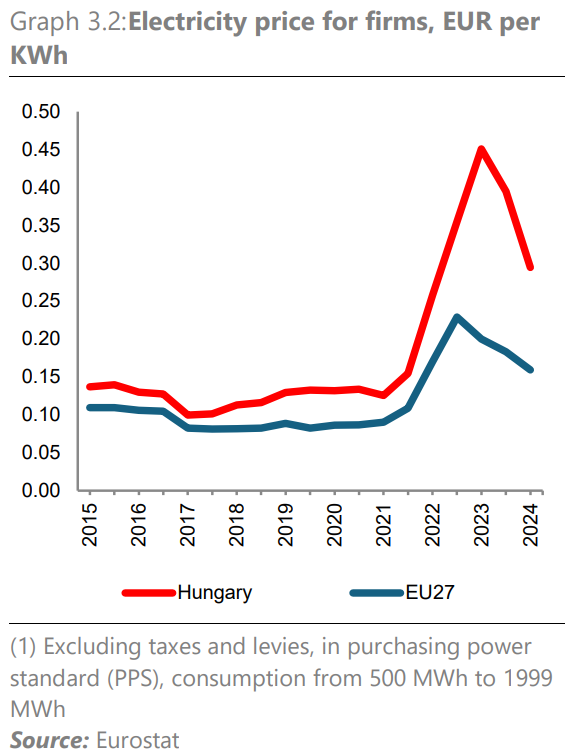
The persistence of high energy prices for companies hinders their competitiveness.
The energy price for businesses in Hungary is one of the highest in the EU due to low competition, burdensome regulations and taxes, and protracted investments in the last decade.
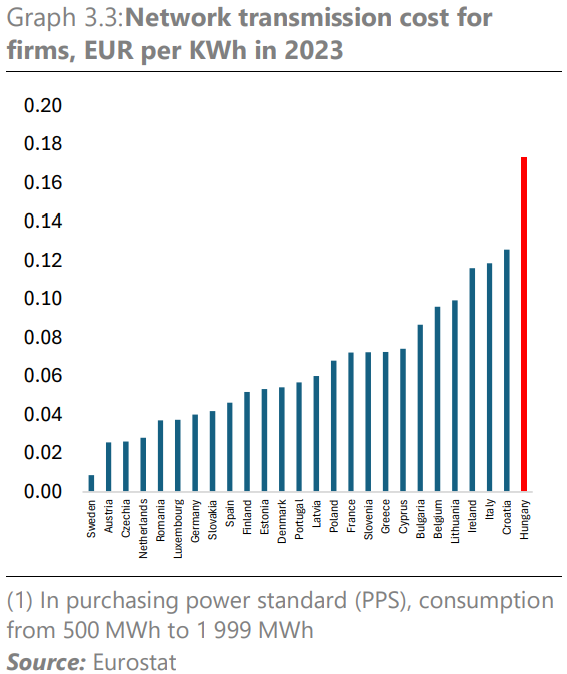
In addition, the regulated low energy prices for households also put an indirect burden on energy prices for businesses. The current system of guaranteed fixed feed-in tariffs (‘KÁT’) for a large part of industrial renewable energy producers creates significant extra costs that are passed on to business consumers (0.2% of GDP in 2024) through the network transmission fee.
The high energy windfall tax (‘Robin Hood tax’) drives up energy prices for businesses and hinders energy companies’ investments in new energy generation infrastructure. It also reduces incentives for setting up power purchase agreements, whose penetration is at this stage very limited. The high electricity price compared to gas acts as a disincentive to decarbonisation.
The EC also says that redistribution policies hardly improve income inequalities. Income inequality (measured by the ratio of total income between the lowest and highest quintiles) stagnated in the last decade, against a higher but gradually improving EU average.
Wealth inequality increased significantly and is among the highest in the EU, with the top 1% of the population holding 33% of the total wealth in 2023.
The tax and social benefit system provides significantly more monetary support to high-income households than it does to the lower income groups. The average social income per person among the top income group was almost three times that of the lowest income group in 2023.
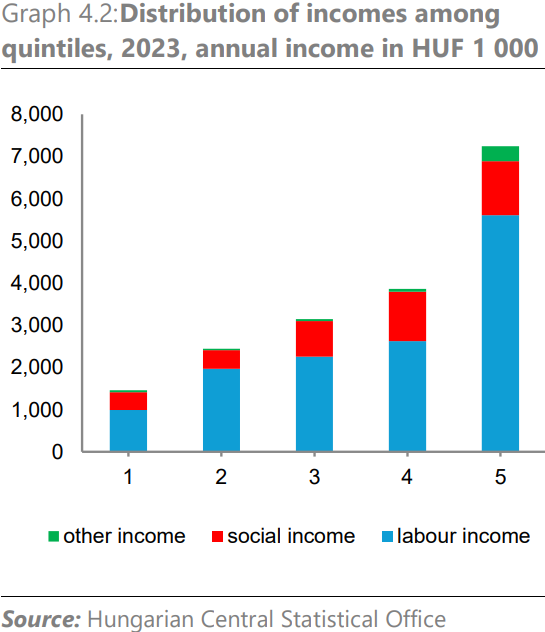
The tax system disproportionately burdens lower-paid workers through the income tax rate and high consumption taxes,
the EC noted.
The benefits of economic growth have not been equally distributed. While the overall poverty indicators perform better than the EU average, poverty outcomes remained worse than the EU average among children in large families, low-skilled workers, older people, persons with a disability and the Roma population.
The situation is relatively worse for the poorest parts of the population due to the low progressivity of the tax system, the decreasing impact of social benefits, unequal access to basic and social services and the poorly targeted tax, housing and energy subsidy schemes.
By contrast, the highest income groups benefit from generous transfers. In addition, the benefits of economic growth are not evenly distributed across the regions, while the country’s least developed districts continue to face multiple barriers to economic and social convergence.
There are some advantages but steps are needed there too
Private investments in Hungary are supported by developed transport infrastructure, low corporate income tax, lax employment protection legislation, low labour costs and generous state subsidies. In 2023, no country in the EU spent more on business support as a share of GDP than Hungary (3%). See the State Aid Scoreboard here.
However, obstacles exist, in particular in the services sector:
Frequent regulatory changes, discretionary state intervention, high energy and banking costs faced by businesses, sector-specific taxes, high interest rates, underdeveloped access to finance, firms' heavy reliance on state subsidies to make investments, and a shortage of skilled workers.
Public investment is facilitated by shorter authorisation and permitting procedures invoking the national interest. However, there are factors which hinder public investments:
Limited access to EU support, persistent problems related to the anti-corruption framework, weaknesses in control procedures, and competition in public procurement, lack of clarity in investment objectives induced by budget constraints.
The implementation of Hungary’s RRP faces considerable challenges.
At present, Hungary has fulfilled 0% of the milestones and targets in its RRP.
"It remains important to accelerate the implementation of cohesion policy programmes. The mid-term review offers opportunities to speed up progress and better address EU strategic priorities related to competitiveness, defence, housing, water resilience and the energy transition."
A recurring criticism of the country-specific recommendations is the lack of competition, which the Commission says also hinders innovation.
Although Hungary has some attractive features for investment, especially in manufacturing, many industries face obstacles and the overall perception of the business environment is rather negative.
Businesses also face a high level of regulatory volatility.
Over the past two decades, the proportion of decrees compared to laws has surged. The frequency of legislative amendments increased as well, which makes long-term business planning increasingly difficult.
the Commission said.
In their view, regulatory unpredictability is further aggravated by limited stakeholder involvement, and also by the fact that the government continues to widely use emergency decrees to regulate.
The ‘state of danger’, which has been continuously extended for the last five years for various reasons, allows the government to amend laws through decrees. "This bypasses parliamentary oversight and public consultation, introducing sudden, often major, policy shifts potentially disrupting normal business operations," the EC said.
The ineffectiveness of the anticorruption framework remains an obstacle to business, according to the EU executive.
A far higher percentage of companies than the EU average consider corruption to be widespread and a problem when doing business,
it said.
The EC added that "the lack of equal treatment of companies limits competition."
According to the World Bank’s Business Ready report, the market structure is concentrated and only a few firms compete in specific markets. Several services are entrusted to state-owned or private firms which operate without competition. Such services include textbook publishing, waste management, mobile payments, the cash-in-transit market, tobacco wholesale and retail trade, gambling, motorway construction and, from 2025, cybersecurity audits.
The government discretionarily exempts mergers and specific investment projects from administrative procedures, creating an unequal playing field for firms and increasing the importance of connections with the state apparatus.
The large-scale use of framework agreements in public procurement procedures also limits competition by locking in certain firms and helping them acquire a dominant market position. The number and value of framework agreements has increased sharply in recent years. In 2023, they exceeded the value of all other tenders and around 70% of them were concluded with a single tenderer.
"The State is active in business transactions and crowds out private actors," the EC said. It pointed out that in recent years, the State purchased an 80% share in Budapest airport (the transaction costs amounted to 2.5% of GDP) and a wide range of office buildings (1% of GDP). It also facilitated the purchase of several large companies such as the third largest telecommunications company (1.2% of GDP) and the creation of the second largest bank with subsidised financing.
Various state interventions have been used to force – mostly foreign – owners to sell their firms, facilitating the creation of public or government-connected national champions.
The EU executive also warned that
the increasing presence of private equity funds creates new challenges.
The number and size of private equity funds have increased significantly in recent years and reached more than 2.5% of GDP in 2024, the EC said, explaining that
This company structure is used in particular by individuals with links to the government as it ensures anonymity, similar to offshore companies.
"Private equity funds are increasingly behind companies winning public procurements and securing high value concessions, and have a strong presence in business transactions with the State. In addition, many private equity funds received public support through the national promotional bank."
"Currently, the Hungarian beneficial ownership register does not contain complete and accurate information on the ultimate beneficial owners of private equity funds. Banks and the Supervisory authority cannot rely on a verified central registry of ownership data to comply with prudential rules on loans to owners of the bank and company group loans if the borrower company or the bank is owned by a private equity fund."
In November 2024, Hungary amended the legislation on private equity funds to complement the database on ownership. However, the database will contain data for already established funds only as of July 2026. Moreover, the tax authority cannot verify the data, and nongovernmental organisations and investigative journalists with a legitimate interest do not have access to it.
Taxes targeting specific sectors (extra profit taxes in 'governmentspeak') increase the prices of services and goods, the EC said.
The cost of banking and energy for firms is one of the highest in the EU.
Money transfers, except low value transactions, are taxed at a rate of 0.45% (up from 0.3% in August 2024). In the euro area, such transfers are free of charge. Banks can also pass on to customers the cost of the bank levy. These two taxes increased banking costs for households and businesses by 0.9% of GDP in 2024. Hungarian households spend 3% of their consumption expenditure on banking, compared with 0.8% in the euro area. A surtax amounting to 0.1% of GDP has been imposed on mobile telecommunication, which contributes to the relatively high cost of mobile telephone services in Hungary. From 2025, medium-sized and large firms in the services sector also have to pay a cybersecurity fee.
According to the Commission, the retail sector operates in an unstable business environment, and the tax burden in this sector disproportionately impacts larger, often foreign-owned companies.
Retailers are also affected by administrative interventions in price setting, such as retail price caps, limits on sales margins and mandatory discounts.
In March 2025, the government introduced a 10% retailer profit margin cap for 30 food products to fight against inflation. A similar 15% margin cap was introduced in May 2025 for 30 personal hygiene and household cleaning products. Legislation on combating food waste contains a prohibits retailers from selling food products 48 hours before their expiry date, potentially disrupting the effective management of inventories. The mandatory online price reporting affecting food retailers (essentially the foreign-owned ones) imposes an additional administrative burden, the EC said.
The Commission said that measures and high taxes in the retail sector decreased their competitiveness. Country-specific factors accounting for high prices include large administrative burdens, the highest VAT rate in the EU (27%), a local business tax (1-2% of the retail margin) and a retail tax (amounting to 4.5% on turnover in 2024).
The high tax burden is a competitive disadvantage, in particular for retail companies operating with low margins, such as food retail, fuel and e-commerce firms.
In the area of research & development, the EC made the following observations:
- 1. Stagnating R&D investment hinders Hungary’s scientific and innovation performance.
R&D intensity increased only marginally over the past decade and remains well below the EU average (1.4%, vs 2.2% of GDP in 2023). "The main obstacles to innovation are the unstable public funding framework, the unpredictable business environment, high interest rates, insufficient access to market-based financing, the low level of high-skilled workers and low entrepreneurial skills among managers."
- 2. Low public R&D spending decreases Hungary’s capacity for fundamental research.
Public R&D spending, including in universities, is one of the lowest in the EU (0.4%, vs the EU average of 0.7%). The low public investment holds back scientific excellence.
- 3. Business R&D benefits from generous government subsidies.
Hungary provides the most generous subsidies to business R&D activity (0.3% of GDP in 2021) in the EU, through direct grants and tax allowances. However, the R&D spending of businesses decreased to 1% in 2023 from 1.2% in 2021.
Entrepreneurship education is limited, according to the EC, which says entrepreneurship education is used in a narrow sense in the national school curriculum, being limited to economic and financial literacy.
There is potential for better use of digital solutions by businesses, the EC said. The proportion of small and medium-sized enterprises with at least a basic level of digital intensity is still lower than the EU average (53.2% vs 57.7%).
The market-based financing of fast-growing small and medium-sized enterprises and start-ups remains limited. Venture capital funding amounted to 0.05% of GDP in 2023, below the EU average of 0.1%. 40% of venture capital investments came from state-owned funds drawing on national and EU funds. This is the highest proportion among EU countries in the OECD.
“While these programmes may temporarily boost venture capital financing, they cannot contribute to long-term market development. Moreover, high interest rates coupled with a frequently changing regulatory environment hinder the financing of innovative start-ups.”
A few more critical notes by the Commission:
- The significant involvement of the State in business financing distorts the efficient functioning of the markets.
- The regulatory burden imposed by certain procedures negatively impacts firms’ investment decisions.
- Incentives skewed towards low-risk investments hamper the development of capital markets.
- The increasing use of sector-specific taxes complicates the tax system and disproportionately impacts non-Hungarian firms
Cover image (for illustration purposes only): Getty Images


