Hungary may lose further billions of euros in EU funds if gov't doesn't take action now


In the 2021–27 EU fiscal cycle, €32.1 billion is available for Hungary in cohesion and reconstruction funds. However, significant amounts of this funding have been frozen by the European Commission in recent years, partly due to the rule of law procedure and partly due to non-compliance with the enabling condition. Initially, more than two-thirds of the total envelope — €21.7 billion in cohesion funds and €10.4 billion in the Recovery and Resilience Facility (RRF) — was blocked in its entirety.
Although Hungary has already gained access to some of the frozen funds — €10.2 billion of cohesion funds were unblocked at the end of 2023 due to judicial reforms, and a further €2 billion in spring 2024 due to improvements in education — the fate of more than €19 billion remains uncertain.
Moreover, the amount has already been permanently reduced by about €1.5 billion (HUF 605 billion). On the one hand, Brussels withdrew €1.1 billion (cc. HUF 440 billion) at the end of last year under the n+2 rule because the funds frozen by the rule of law procedure could not be replaced by corresponding reforms. This is because, under the new budgetary rules, frozen funds must be released within two years of the freeze or they will be withdrawn completely.
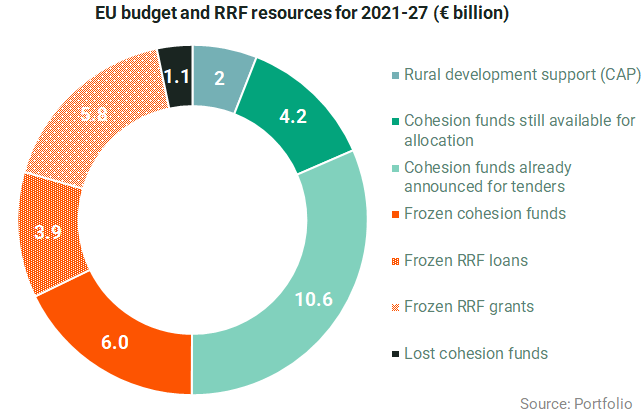
Secondly, the European Commission has already blocked more than €450 million in fines, comprising a one-off payment of €200 million and interest-bearing fines of €1 million per day, imposed by the Court of Justice of the European Union due to non-compliance with EU rules by the Hungarian asylum system. This is not marked on the graph specifically because the European Commission can recover these fines from any funds to which Hungary is entitled, which could result in reductions to the cohesion and agricultural funds.
Although the legal disputes and professional negotiations between the Hungarian government and the European Commission have been at a standstill for around a year and a half, a new risk factor has emerged: the EU's "n+3" rule.
This stipulates that EU commitments approved for Hungary in a given year — i.e. funds committed — must be settled financially within three years at the latest. If this deadline is missed, the unused portion of the funds will automatically be returned to the EU budget.
This rule therefore dictates that amounts committed in 2022 must be spent and accounted for by 31 December 2025 at the latest. However, due to political debates, institutional delays and reform conditions in recent years, a significant proportion of accumulated funds are still unable to be allocated to projects or used for actual payments in time.
In addition, operational programmes have also been implemented slowly. The accumulation of funds due to delays is now putting concentrated pressure on the Hungarian administration.
This situation is particularly dangerous because unused funds may be lost forever, rather than becoming available at a later date. The fate of thousands of billions of forints in EU funding depends on the Hungarian administration speeding up the process of drawing down funds, closing suspended programmes and accounting for available funds in the coming months. What is at stake is not only access to funds, but also the risk of losing them for good.
They must hustle with the tenders
As we discussed in last week's Portfolio webinar with Alex Papadimitropoulos, Managing Director of Caprica Consulting, official statistics show that there are significant backlogs, particularly within the Economic Development and Innovation Operational Programme Plus (EDIOP Plus), which primarily focuses on business development.
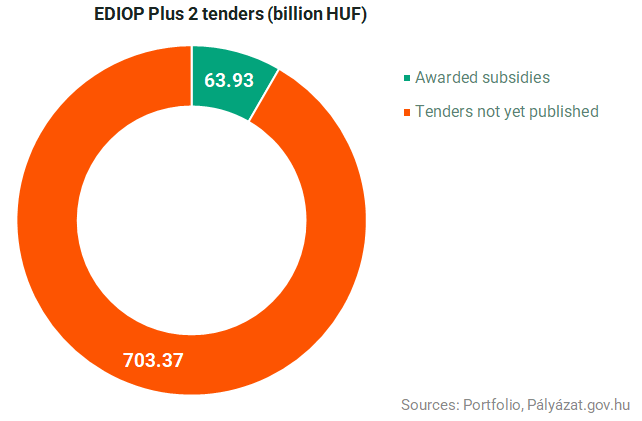
With a total budget of around HUF 770 billion, the EDIOP Plus 2 priority axis is the most vulnerable, with only around HUF 236 billion having been put out to tender. Based on the current rate of tendering, there is a risk of losing resources, but the tender expert expects the pace of tendering and evaluation of existing tenders to pick up in the coming months.
Tens or even hundreds of billions of forints are expected to be put out to tender in the coming months. This is because, if this does not happen by autumn 2025 at the latest, some of the remaining unspent funds will be lost.
The managing authorities are already under considerable pressure. To start committing resources in a timely and meaningful way, the rapid invitation of tenders and simplified application criteria are needed.
In his presentation, Alex Papadimitropoulos noted that administrative review processes typically take four to six months, meaning all calls for tenders must be closed by October–November if funding decisions are to be made by early 2026.
Member states can usually request that the European Commission negotiate a rescheduling of the commitment periods, but no action has yet been taken. The tense relationship between the EU executive and the Hungarian government also suggests the risk of a flood of tenders.
In addition, the proximity of the 2026 elections is a factor, as there is usually a series of calls for tenders before elections. This is not only due to the campaign period, but also because processing and tendering usually takes six months due to the formation of a new government.
Cover image (for illustration purposes only): Getty Images