Hungary's Orbán expects to receive a "strong offer" at EU summit


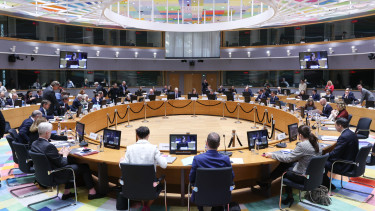
Although no major decisions are expected to be made at the summit on 26–27 June, the participating heads of government will certainly prioritise discussing the 5% defence budget agreed at the NATO summit and how to achieve it.
Upon his arrival, the Hungarian Prime Minister responded to several questions regarding the results of the Voks 2025 opinion poll on Ukraine's accession to the EU, which he had just read out. Orbán stated that Hungary's position on the matter was unassailable, citing the fact that 95% of the nearly two million respondents were opposed to Ukraine's entry.
Okay, let's stop for a second! This poll serves no purpose other than that of the previous 'national consultations'. What Orbán is waving in Brussels is just a scrap of paper with fake data on it, such as the number of respondents and percentages, regarding an issue that has been chosen for political gain in the face of Orbán's biggest electoral challenge yet: the newly established Tisza Party, which is headed by Péter Magyar, a former member of the Fidesz family and the ex-husband of former Justice Minister Judit Varga.
The government's propaganda machine was in full swing before and during the vote, besmirching Ukraine and arguing that its accession to the bloc would lead to the demise of Hungarian farmers and open the door to Ukrainian weapons, drugs, and human smugglers.
Initially, strict security measures were in place, such as security paper, UV-verified ballot paper and notarial certification. However, these were thrown out once it was realised that not enough ballots had been returned. They opened online voting, too, but it was ridiculously vulnerable to abuse. Essentially, you could vote as many times as you wanted; you just had to create email addresses — all other information was irrelevant (even if you voted as a 101-year-old Donald Duck living at 1 Kossuth Square).
In any case, the outcome of the opinion poll — which Orbán was careful not to turn into a referendum with believable results and thus some legal relevance — matters exactly zilch in legal terms.
Although the meeting will address Ukraine's potential membership, no substantive vote will be held. The agenda will focus on sustaining support for the country and establishing peace as swiftly as possible.
Nevertheless, a more serious debate could be held on the sanctions in force, which expire at the end of July, and on the 18th package, which primarily targets the Russian energy sector. According to a statement by Foreign Minister Péter Szijjártó on Monday, these are opposed by Hungary and Slovakia in advance.
In response to a question from the press, Orbán said that
he had received some very strong offers from the EU High Representative for Foreign Affairs, Kaja Kallas, in exchange for signing the new sanctions measures. However, he added that they were still working on the matter.
Speaking at a press conference this week, Kallas said that "Hungary blocking a package is nothing new", but that they had put together a strong sanctions package and would consider what compromises needed to be made.
Regarding the tariff negotiations with the United States, Orbán said that the problem is that, although the US has strong negotiating positions, EU negotiators are weak. He was presumably referring to Trade Commissioner Maroš Šefčovič, who had been attempting to negotiate the terms of the tariff war prior to its announcement in April. However, the Trump administration was not particularly receptive to his efforts.
When asked about the Hungarian economy taking off in early 2025, the Prime Minister said:
The runway is long and there are ten million of us on the plane. Just be patient and we'll do it!
Macroeconomic data tell us otherwise. GDP contracted q/q in January-March. It was the sixth lowest data in the European Union, and the 0.4% yr/yr contraction was the third worst figure in the bloc. The first quarter was really bad for industry, which is suffering due to weak export demand, and construction too, although some recovery has been seen since then. Investment is in free fall because of a lack of public and EU resources for development, as well as low private sector confidence. Meanwhile, private consumption growth is failing to translate into growth. Inflation unexpectedly increased to 4.4% year-on-year in May. The budget deficit reached more than 71% of the annual cash deficit target by the end of April, and the 2026 budget adopted by Parliament earlier this month is also full of 'landmines'. Meanwhile, the government is fighting the increasing financing need by FX bond issuances. The above factors have prompted analysts, the central bank and the government to revise growth estimates downwards, although the government has not yet made such sharp downward adjustments.
The EU's migration pact has also been discussed. This would impose stricter immigration and asylum rules on member states, although these would still be more relaxed than those in many other countries. In response, Viktor Orbán said that
Hungary could do nothing but "rebel" against the draft.
Cover photo: EU