EU and US reach long-awaited trade agreement – many have reason to celebrate

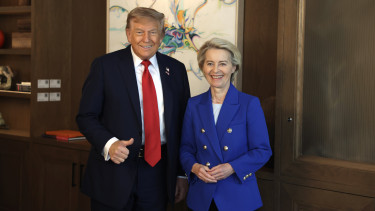
On Thursday, the United States and the European Union announced the details of a new trade framework, which was agreed upon after heated discussions and mainly affects the pharmaceutical, semiconductor, and automotive industries, according to the agreement statement and explanatory note posted on the European Commission's website.
Under the agreement, a uniform customs duty of 15% will apply to several EU export products from September 1.
It is important to note that the agreement is beneficial for the EU in that
it imposes significantly milder sanctions than the 100%–250% tariffs previously proposed by Washington.
However, the framework agreement stipulates that the EU must purchase US energy worth USD 750 billion and invest at least USD 600 billion in the United States – but the recent announcement refers to these obligations as intentions rather than guaranteed commitments.
They cannot be codified as specifics because the European Commission, which conducted the negotiations with the Trump administration, cannot make such commitments, as these fall within the competence of member states or companies.
The details presented above reveal that in the case of several products – such as aircraft, aircraft parts, generic drugs and the active ingredients needed for their manufacture – the US only applies general MFN tariffs (Most Favored Nation tariffs, i.e. the lowest, preferential tariffs that can be applied).
In the case of the pharmaceutical industry, tariffs have been capped at 15%—a significant concession compared to Trump's earlier threats of 250%.
At the same time, the White House is maintaining its pricing policy for generic drugs, which ties US prices to the price levels of other developed countries. Trump has been criticizing the sector for months for "excessive pricing" and encouraging drug manufacturers to move their production to the United States, to which several large companies—such as Novartis, AstraZeneca, and Roche—have already responded with US investments.
Semiconductors and wood products are also subject to a 15% cap, which is significantly lower than the 100% tariff Trump threatened in the spring.
In the automotive industry, the agreement stipulates a conditional total tariff of 15% that will only come into effect if the EU introduces a reduction in customs tariffs on industrial products. This is a significant easing compared to the 30% US threat, but European car manufacturers, especially German ones, are still expecting billions in additional costs each year.
As part of the new trade framework, the EU has agreed to abolish tariffs on US industrial products and to open up its market to US agricultural and fishery products on a large scale.
In addition, the statement confirmed that Europe will also "significantly" increase its procurement of US defense and military equipment, while at the same time seeking to strengthen its own defense industry. Although Trump hailed the agreement as "the biggest trade deal ever," in practice it remains questionable whether the EU's energy and investment promises will actually be fulfilled and what impact the compromise tariffs will have on the competitiveness of the European economy in the longer term.
Still many unclear issues, negotiations continue
Maroš Šefčovič, European Commissioner for Trade, spoke at a press conference on Thursday about the successful conclusion of a joint statement between the EU and the United States, which provides a framework and roadmap for future trade and investment relations. He said that
the agreement was a first step that could be extended to other sectors over time and would bring predictability for businesses.
The commissioner emphasized that the United States has agreed to a 15% comprehensive tariff ceiling on EU products, which is more favorable than the terms offered to any other partner. The tariff ceiling affects most sectors, including the automotive industry, pharmaceuticals, semiconductors and wood products, and complete tariff exemptions have been established in several areas, such as aircraft, generic drugs and certain chemicals.
Among the details, Šefčovič emphasized that customs duties on cars and parts will also be reduced to 15% from August 1.
The parties also agreed to take joint action against steel and aluminum overcapacity and are considering tariff quota solutions to ensure secure supplies. The EU has agreed to remove tariffs on US industrial products and provide broader market access for US marine and agricultural products. In terms of energy security, the European Union will purchase US LNG, oil and nuclear products worth USD 750 billion by 2028, and will also provide US chips for artificial intelligence worth at least USD 40 billion for European data centers. At the same time, European companies are planning to invest USD 600 billion in strategic US sectors, and the EU will also increase its US defense procurement to strengthen NATO compatibility.
The commissioner emphasized that the alternative to the agreement would have been a trade war, which would have jeopardized jobs and growth, so reaching an agreement was definitely a success.
He emphasized that around five million European jobs were at stake, particularly in small and medium-sized enterprises. The agreement thus created stability and confidence and strengthened the transatlantic partnership in an uncertain geopolitical environment. At the same time, he acknowledged that
no breakthrough had yet been achieved in a number of important areas.
Responding to questions, Šefčovič explained that it had not been possible to achieve a reduction in customs duties on wines, spirits and beer. However, he made it clear that the matter was not closed and that the EU was continuing to work to include these products in the concessions. Similarly, the full liberalization of steel and aluminum remained an open issue, although the parties see mutual interests in this area. In the area of digital trade, the joint statement refers to certain "unjustified non-tariff barriers," but the commissioner emphasized that this does not apply to the DMA and DSA legislation, but rather to the modernization of technical rules.
The parties completely left the issue of digital service taxes out of the agreement, as this falls within national competence.
He mentioned further uncertainty regarding the coordination of so-called investment screening mechanisms, particularly in the area of outward investment. Šefčovič indicated that the Commission is working on an economic security doctrine, which it intends to adopt in close consultation with Member States. This applies in particular to the security of supply of sensitive technologies, such as AI chips or critical raw materials. According to the Commissioner, the attitude of Member States is gradually changing and there is a growing willingness to find common solutions, but the issue also touches on questions of national sovereignty, so a unified position is still being developed.
At the press conference, it was also revealed that the negotiations had been concluded after long and intensive discussions. Šefčovič said that they had made more than ten trips to Washington, held more than 120 hours of negotiations, and that every detail had been approved by the White House. This procedure was partly explained by the fact that US President Donald Trump was personally involved in trade matters. According to the commissioner, all this contributed to the development of strong personal relationships with American partners, which they intend to capitalize on in future cooperation.
The EU is now preparing to transpose the agreement into law, but considers the declaration to be only a starting point that can be extended to other areas.
Cover photo (for illustration purposes only): EU