Mario Draghi: 2025 is the year when all illusions about Brussels' supposed power vanished

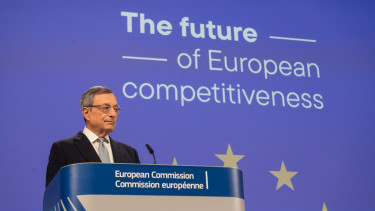
For years, the European Union believed that its economic size, with 450 million consumers, brought with it geopolitical power and influence in international trade relations. This year will be remembered as the year in which this illusion evaporated,
- Mario Draghi, former president of the European Central Bank and former Prime Minister of Italy, opened his speech at the recent annual Rimini Meeting.
Draghi presented his competitiveness report last year, which he prepared at the request of Commission President Ursula von der Leyen so that the EU could see more clearly its weaknesses and what it needs to do to become a decisive factor in international economic competition once again.
The situation was not very bright even then, as 27 countries following their own strategies cannot compete with China or the US, where in many sectors a handful of players can sometimes absorb all private and public investment.
This challenge was compounded this year by the inauguration of US President Donald Trump, who served as a “very brutal wake-up call” for the EU elite.
Although representatives of the European Commission usually try to calm things down, it has now become clear to them that security cannot be guaranteed without military capabilities, and until the EU can demonstrate this strength, it will only be invited to the negotiating table out of courtesy, but will have no real say in matters.
According to him, this is clearly illustrated by the fact that, despite the EU having contributed the most financially to Ukraine's support, it plays only a "marginal" role in Trump's peace plans, can only act as an "observer" in the Gaza conflict, and China has recently made it clear that it does not consider Europe an "equal partner."
In its current form,
Europe is ill-equipped in a world where geo-economics, security, and stability of supply sources, rather than efficiency, inspire international trade relations,
said the former Prime Minister and ECB President.
According to Draghi, with this in mind, defense spending would probably have had to be increased anyway, but it is not advantageous to have to do so now according to the rules of the US, just as it is not right that the EU had to resign itself to the tariffs imposed lightly by its "largest trading partner and long-standing ally."
In his view, there are historical reasons for this: after the world wars, the EU was created to prevent neighboring countries from trying to enforce their economic ambitions by force. This was accompanied by a gradual reduction in state intervention capacity and the opening up of markets.
However, on the one hand, this work has not been completed to this day, and on the other hand, no one anticipated that the rest of the world could turn away from this approach at any time.
Draghi referred to the former when he mentioned the completion of the internal market, as eliminating administrative burdens and other barriers between EU member states would not only make it possible to compensate for a significant portion of the trade shortfall with the US, but, according to some estimates,
could also increase the continent's productivity by 7% within the foreseeable future.
These internal trade barriers also pose serious obstacles to arms ambitions. Although EU countries want to increase their military investments by €2 trillion by 2031, our internal restrictions impose a 64% tariff on equipment and a 95% tariff on the metals needed to manufacture it.
Although the US is expected to benefit from most of the member states' military spending during the remaining three years of Trump's presidency, Draghi believes it is essential for the EU to take out a joint loan to increase spending on defense, research and development, shared infrastructure, and truly groundbreaking technologies, as this is the only way the Union can finance its long-term plans.
Draghi said that these goals could never be achieved through national efforts alone, so governments must make decisions on industrial and trade policies, reduce barriers, and agree on how to finance the significant investments that will be needed in the future.
He estimated that this would amount to roughly €1-2 trillion per year, which is comparable to the EU's total spending for the next seven-year cycle.
For all this to succeed, Draghi believes that the EU's leadership structure also needs to be reformed, as it was originally calibrated to support governments. This good-faith approach has been sufficient for many things in recent decades, and the bloc has thus achieved much more than its members could have achieved individually, but serious political reforms will be needed, as Draghi put it,
to face today's challenges, the EU needs to shift and turn from an extra or a supporting role to the key player.
Címlapkép forrása: EU





