Negotiations underway on the accession of the EU's next potential member state

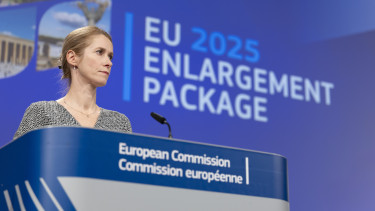
As expected, High Representative for Foreign Affairs Kaja Kallas and Commissioner for Enlargement Marta Kos announced that Montenegro has the best chance of becoming a full member of the European Union in the near future.
On Tuesday, the two committee leaders presented the European Commission's enlargement report, which assesses in detail the progress made by candidate countries towards EU accession. Negotiations are currently underway with 9+1 countries, so the document examines the situation in
Montenegro, Moldova, Albania, Ukraine, North Macedonia, Serbia, Bosnia and Herzegovina, Georgia, Türkiye, and Kosovo, which has not yet been recognized by the five member states.
It is no coincidence that Montenegro has a relatively easy task: with a population of 650,000, it is a tiny speck in the sea of EU member states. Its GDP of roughly €7.5 billion is only a fraction of Hungary's, but the per capita figure also shows a significant gap: compared to Hungary's €28,700, Montenegro's GDP per capita is only €11,000.
In addition to the fact that, given the size of the country, there are few concerns that can be raised against it, Montenegro is de facto the best candidate, according to Kos, as four chapters have already been closed this year and a further 5-6 are expected to be completed before the end of the year.
In broad terms, Kallas said that,
-
in addition to Montenegro, Albania, Moldova, and Ukraine received positive scores,
-
while most countries stagnated, failed to make significant progress, or showed worrying trends, thereby weakening their status.
-
Georgia, on the other hand, underwent such a regression in the rule of law under its pro-Russian government that it remained a candidate country in name only.
Kallas also emphasized that it is always extraordinary when the EU opens up the possibility of enlargement, which also means that only countries that strengthen the geopolitical power of the union can join. Accordingly, we can expect several countries to join by 2030.
Montenegro has set itself the goal of concluding negotiations by 2026, Albania by 2027, and Moldova and Ukraine by the end of 2028.
Although Kos's words suggested that these targets might be overly ambitious, the commissioner emphasized how important it was to work so determinedly toward accession.
This is particularly true for Albanians, who have made record progress over the past year and whose population has the highest level of support for EU accession, at 91%.
Behind the nice words, a slow process is apparent in Ukraine's case
Since the outbreak of the Russia-Ukraine war, Moldova and Ukraine have been working hard to meet EU requirements. The former is particularly vulnerable to hybrid interference due to the presence of Russian forces in Transnistria, but despite this, it managed to elect a pro-EU government at the end of September, while Kyiv is working on the necessary reforms under direct pressure from the war.
Of course, there is still much to be done in both countries: Kos, who recently visited Transcarpathia, emphasized that in Ukraine's case, there is still much room for improvement in terms of corruption.
Despite the positive assessment, it is striking that Ukraine and Moldova are still only in the review phase and have not yet opened any of the 31 chapters.
According to Kallas, this is a cause for concern for 26 of the EU's 27 member states, referring to Hungary, which has not yet given its blessing to the progress.
Kos was somewhat defensive on this issue, saying that, on the one hand, they are working to get the Council, which comprises the member states, to give the Commission a mandate to help the process move forward in working groups without opening chapters. On the other hand, he also stated
that it is "not Orbán's job" to carry out the reforms, so Ukraine and Moldova can continue their work on fulfilling the conditions in the meantime.
Of course, the most frequently asked question is about guaranteeing the rule of law, and according to Kos, most decision-makers would like to see even stricter requirements for new member states in this regard. The fact that several countries have slipped down the imaginary ranking because of this clearly shows that steps taken in this direction are not just items to be ticked off a list, but must become lasting reforms.
Resilience to hybrid threats, election interference, and other foreign intelligence activities—currently primarily Russian—has become a confirmed expectation, which will be thoroughly examined before candidate countries are admitted to the Union.
All that said, if Montenegro does manage to conclude negotiations by 2026, accession could happen by 2028, which Ursula von der Leyen described as a rather ambitious goal during her visit in October. Regardless of the feasibility of the target date, however, there is no doubt that
Montenegro will become the 28th member state of the EU.
Cover photo (for illustration purposes only): EU





