Hungarian housing market has not seen such a slump in ten years - What can we expect this year?


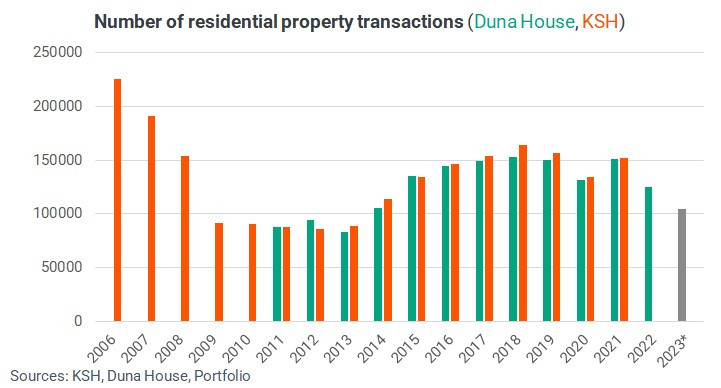
There were three years in the history of the modern Hungarian housing market when the annual number of transactions did not reach 90,000. All of these occurred during the post-2008 crisis trough between 2011 and 2013. Neither before nor since has the number of homes changing hands in a year been so low, but many see a similar period ahead again.

Looking only at the months of December, there were only two years in which demand was lower than in 2022, in 2012 and 2013, when 6,061 and 5,768 homes changed hands respectively. In the last 12 years, the weakest month was January 2011, when Duna House estimated that 5,183 apartments were sold, while March 2021 holds the positive record, when 15,630 apartments were sold, partly due to the coronavirus-related pent-up demand driving the market.
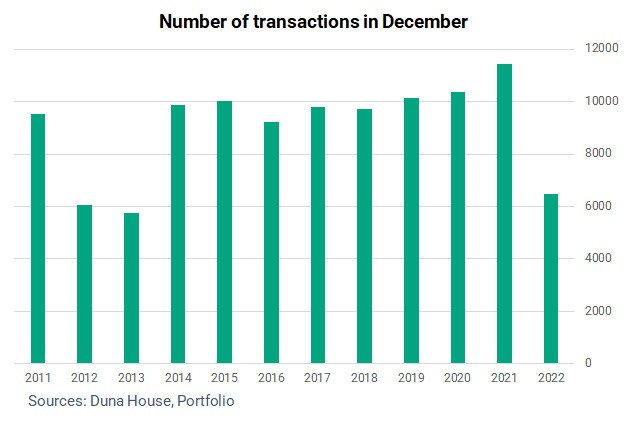
In addition to expensive credit and the deteriorating economic environment, uncertainty around various family support elements may have played a role in the negative performance in December. However, these have since been clarified and most have been extended, remaining available in 2023:
- the Home Purchase Subsidy Scheme for Families (CSOK) of between HUF 600,000 and HUF 10 million available to all Hungarians with children or planning families
- the so-called 'village CSOK', for loans between HUF 300,000 and HUF 10 million;
- the 0% interest prenatal baby loan of up to HUF 10 million and the accompanying baby grant;
- the HUF 1 million and HUF 4 million mortgage waivers,
- debt relief for mothers' student loans, which the government has even extended with a new form of support (see below)
- the CSOK loan with a fixed interest rate of 3% of up to HUF 10 million for families with two children and of up to HUF 15 million for families with three children ;
- 5% VAT refund on the purchase of housing and 27% VAT refund on construction works (the former only for CSOK beneficiaries, the latter up to HUF 5 million),
- exemption from the 4% property acquisition tax for CSOK beneficiaries.
In particular, the baby loan is the one that can boost demand in the housing market, as with high market interest rates it may be the only alternative for many people to supplement their available equity. Although many people have already used this support for house purchase in the past, its share could increase in the future. In addition to the baby loan, the village CSOK could also boost the rural housing market.
What demand should be expected this year?
This year's housing market may be shaped by conflicting trends, but overall there may be a preponderance of those that predict a further decline in demand. According to ingatlan.com, the number of enquiries in the last month of 2022 also fell by more than the number of sales, by 53% compared to the same month last year. This is confirmed by sellers, who report longer selling times and higher price tags.
Further growth in demand is to be stymied by lending rates remaining high, which makes it impossible for a significant proportion of owner-occupiers to buy, pushing them towards holding out or renting. It is no coincidence that already last year there was a noticeable increase in the proportion of investment purchases, mainly due to a fall in owner-occupied purchases. At current inflation levels, no interest rate cuts are expected for the time being, so this trend could continue in 2023.
Last year, the housing market started to split along a new line. As a result of the energy price boom, demand for well-insulated, low-consumption housing has increased, while poor-quality, low-energy-efficiency, large houses have become much harder to sell.
Although energy price rises appear to have stopped for the time being, preventing the sudden fall in property prices that many had expected, the cost of maintaining a home may continue to play a much bigger role in the saleability of a property than in previous years. The renovation of 'old-fashioned' / obsolete homes and the construction of new dwellings may therefore be a priority, to which the extended public subsidies mentioned above will continue to contribute, ableit to a lesser extent.
Despite this, experts polled by Portfolio at the end of last year forecast both housing starts and sales to fall in 2023. According to the average of experts' expectations, the former could be around 18,000 this year, i.e. the number of dwellings that could receive the occupancy permit, while
THE NUMBER OF SALES COULD BE AROUND 105,000.
So, as far as housing starts are concerned, although there would need for a lot more new homes, the above estimate is still double the all-time lows. Also, if analysts' expectations for the number of sales are met, demand this year could be roughly 15-20% higher than in the aforementioned years between 2011 and 2013.
Where and what could be the hottest items?
We have also dealt with this question in previous articles, but it is worth looking again at how real estate experts polled at the end of last year answered the question "where and for what type of housing will demand pick up this year?"
- "Demand will not pick up in 2023, with all segments expected to contract." (Dávid Valkó - OTP Mortgage Bank / OTP Real Estate Point)
- "There will not be a boom in any type of property next year, at most the Buda districts, for example, or renovated panels will avoid a decline." (Edit Vincze - OC Solutions)
- "Next year, energy-efficient properties shielded from surging utility bills will be more in demand." (Ákos Balla - Balla Real Estate)
- "Relatively compact, modern properties with a good energy rating (at least CC) in larger cities and county capitals will be more in demand." (Tamás Kricsfalussy - Metrodom)
- "Once again, Budapest's city centre will be the place to be, the better renovated an apartment is, the better." (Dániel Csorba - real estate appraiser, blogger)
- "There will be a growing demand for energy-efficient, well-located, modern or new homes in large cities." (Gábor Kiss - IFK)
- "In any case, demand will be strongest for energy-efficient (new or renovated) properties, in cities and their surroundings where the main employers are either not affected or only slightly affected by the recession, i.e. where there are no mass redundancies." (Zoltán Sápi - Eltinga)
- "Newly-built apartments in the capital, energy-saving new(ish) homes in the countryside, and small brick apartments will be the hit in 2023. There could be strong demand for housing available alongside industrial investment projects with high human capital requirements, for example in Debrecen." (Ákos Kiss - Property Market)
- "We expect continued strong interest in newly-built, modern housing. As for second-hand housing, in addition to flats with smaller floor areas, there will be stronger interest in detached houses that already have modern energy features or offer alternative heating options, possibly with minor investment to convert them." (Károly Benedikt - Duna House)
Cover photo: Getty Images


