Where is home buying the most affordable in Europe and where is Hungary ranked?


In terms of price levels in the European Union's capitals, Paris's top position remained unassailable even in 2023. The French capital ranks as the most expensive city to purchase a new dwelling in Europe in 2023, at an average of 14,900 EUR/sqm (HUF 5.9 million).
Munich stood at 10,900 EUR/sqm (HUF 4.3 mn). (The top three cities that cost more than 10,000 EUR/sqm also included Tel Aviv (13,886 EUR/sqm) on the second place. Prices within the 7,500-10,000 EUR/sqm range were found in only three European cities: inner London - 8,018 EUR/sqm, Amsterdam - 7,850 EUR/sqm, and Frankfurt - 7,700 EUR/sqm.
Interestingly, there are some quite expensive cities that are not the capitals of their countries. They include Antwerp, Tel Aviv, Munich, Milan, Cluj Napoca, and Barcelona. Such a wide range shows that important economic hubs other than capitals can have high property prices in their countries as well.
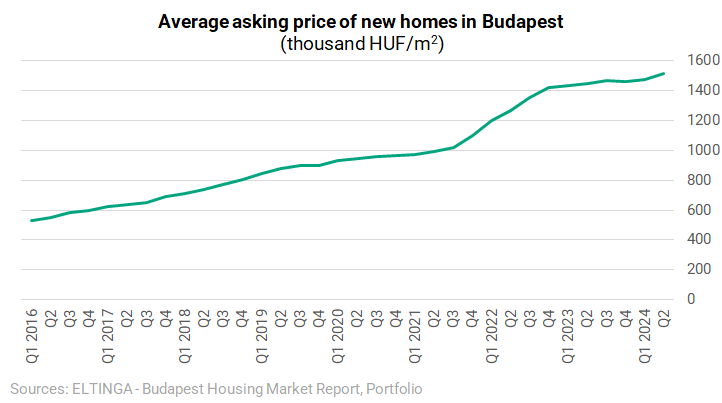
New homes in Prague (€5,153 / HUF 2 million) and Bratislava (€3,884 / HUF 1.5 million) are also much more expensive than the average price of €3,260 (HUF 1.3 million) per square metre in Budapest, but the price level in Warsaw is slightly lower (€3,022 / HUF 1.2 million).
Although the KSH data show that the average price per square metre of new apartments in Budapest is indeed HUF 1.3 million, these values are not included in the statistics at the time of sale, but at the time of the issuance of the occupancy permit. This is why the latest supply data from Eltinga's Budapest Housing Market Report provides a more accurate indication of the latest prices, which show that new apartments in Budapest go for already around HUF 1.5 million per square metre, similar to Bratislava.
Conversely, not even one of the 69 European cities considered in the survey recorded an average transaction price lower than 1,000 EUR per square meter. The lowest average transaction prices were recorded in Patra (1,203 EUR/sqm; Greece), Niš (1,373 EUR/sqm; Serbia), Brasov (1,618 EUR/sqm; Romania), Győr (1,621 EUR/sqm; Hungary), and Banja Luka (1,622 EUR/sqm; Bosnia and Hercegovina).
For the past two years, the trend in average prices of all transactions of dwellings in capital cities has been influenced by changes in the average exchange rate of selected currencies. The highest increase came from Budapest, where transaction prices went up by 11.2%. Next in line was Warsaw with 9.7%. It is followed by Oslo with 7.2%, Belgrade 2.9%, and Prague with 1.8%. To that respect, four capital cities recorded a fall over the past two years. Guidelines show residential prices declined by 12.5% in London-inner, by 7.2% in Copenhagen, by 4.7% in Bucharest, by 3.5% in Jerusalem.
Following price falls of 18.8% in the UK and 9.7% in Denmark in 2022, new house prices in the two countries continued to fall, albeit at a much smaller rate at 3.3% and 3.8%, respectively. Average transaction prices dropped the most in Italy in 2023 (-10.7%).
Among participating countries, Israel reclaimed its title as the most expensive country in 2023 with an average transaction price of 5,439 EUR/sqm. The second place remains stable compared to the previous edition: Austria, whose prices amounted to 4,920 EUR/sqm (HUF 1.95 mn) on average. Germany closely follows Austria with transaction prices of 4,700 EUR/sqm (HUF 1.85 mn) on average. France and the Netherlands completed the five priciest countries list in 2023 with average prices of 4,538 EUR/sqm (HUF 1.8 mn) and 4,266 EUR/sqm (HUF 1.7 mn), respectively.
"Overall, we have seen very significant and often opposite price movements in Europe over the last four to five years. With the dynamic increase in house prices in Central and Eastern Europe, the previous significant gap in price levels between the more developed regions of Europe and the emerging Central and Eastern European countries has narrowed.
"For example, by 2023, the average unit price of new housing in Italy (€2,118 / HUF 850,000) was below the unit price level of all Visegrad Four countries, but in Italy, second-hand housing is already cheaper than second-hand housing in the Czech Republic, Slovakia and Poland," said Gábor Kohári MRICS, a real estate consultancy expert at Deloitte Hungary.
Initiated dwellings
Of the 24 countries surveyed, Hungary had the fourth lowest number of dwellings per 1,000 people in 2023, similar to 2022.
In 2023, the number of building permits per 1,000 inhabitants was also the fourth lowest (2.24) in Hungary and significantly lower than in 2022 (3.62), which means that Hungary's position in the ranking of European countries in terms of the number of building permits in 2022 further eroded in 2023.

Renting is expensive in Europe
As it has every year, Property Index contains a comparison of the price level of rents in selected cities in Europe in participating countries.
Given the available data, the most expensive European city to rent is London (inner) - its price has reached 33.8 EUR /sqm. London (inner) is followed by Dublin, where rental prices are 31.5 EUR/sqm, and then Paris - 31.3 EUR/sqm, but Barcelona also was north of the EUR 30 mark (30.6 EUR/sqm).
Budapest's €11.3 is the 18th lowest of the 59 European cities surveyed, and is below the rents in the capitals of the region.
Otherwise, similar unit rents to those in Budapest can be seen in the housing markets of Linz, Graz and Athens.

How long you have to work to buy a home?
The most representative indicator for the publication of the Property Index is the affordability of owner-occupied housing in each participating country.
As in the previous editions, affordability of owner-occupied housing is estimated as the number of average gross annual salaries required to be able to pay for a standardised new home with floor area of 70 square metres in each country.
The affordability of owner-occupied housing have not changed significantly in European markets in 2023. For example, in Hungary 10.2 years in 2023 is the same as in 2022.
The latest data indicates that
the Czech Republic is the least affordable country for home ownership among the 18 countries surveyed.
A standard new dwelling purchase requires Czechs to invest an equivalent of 13.3 gross annual salaries, a figure that has remained largely unchanged since the previous edition of the Property Index.
Slovakia has been dethroned as the least affordable country to buy an average new home. In 2023, an equivalent of 12.7 average gross salaries is needed to buy an average new home, which is 1.4 average gross salaries less when compared to the last year’s edition. Following Slovakia, countries like Israel, Ireland, and Hungary require an average multiple of 10.2 gross salaries to purchase a new residence. Compared to the previous report, the situation of buyers in Israel and Hungary stays similar as last year, while those in Ireland must set aside an equivalent of 0.5 more gross annual salaries to purchase a new dwelling.
Citizens of Serbia, France, and Croatia will have to save an equivalent of between 8 and 10 gross annual salaries in order to buy a new apartment.
In countries like Poland, Bosnia and Hercegovina, the Netherlands, the UK, Slovenia, and Greece, the cost to purchase a new dwelling stands between a multiple of 6 and 8 gross annual salaries. New buyers in Romania and Italy have to save an equivalent of between 5 and 6 gross annual salaries to be able to buy a new home.
Finally,
the most affordable country to buy a new home is Norway, and Denmark, where citizens need an equivalent of less than five gross annual salaries to buy their own home.
Citizens of Norway need to save 4.8 gross annual salaries. The most affordable country to buy a new home is Denmark, where homes cost a mere equivalent of 4.7 gross annual salaries.

Different financing costs
In 2023, average residential mortgage market interest rates diverged significantly across Europe.
The highest retail mortgage market interest rate was 8.1% in Poland, while Romania and Hungary recorded 7.7% and 7.4% respectively. At the same time, subsidised loans at significantly lower rates than market rate loans were available in Hungary in 2023, which contributed greatly to improving the affordability of owner-occupied housing.
On the flip side, the lowest average mortgage rates were observed in Bulgaria (2.6%), Spain (3.1%), Croatia, and Belgium (3.3%), Slovenia, Portugal, and France (3.6%), Israel, and Slovakia (3.8%), and Austria (3.9%).
Mortgage rates in the EU's largest economies, Germany and France, were slightly higher at 4.06% and 3.63% respectively, while in Italy, which suffered a very significant fall in house prices in 2023, the average rate was 4.72%, much higher than the average borrowing rates in countries with similar economic development.
"According to the 9th edition of the Deloitte Property Index, mortgage rates were still below 2.0% in most European Union countries in 2019, with average rates of 1.20% in France, 1.6% in Germany and 1.70% in Italy.
"The significant and sustained increase in financing costs, as well as rising energy prices and uncertainty about energy availability, have left a lasting mark on the European housing market, and the overall outlook for the housing market in 2024 remains less than favourable," underlined Gábor Kohári.
Built-to-rent housing market
"The combination of higher borrowing costs and rising property prices has worsened housing affordability, particularly in urban centers where demand exceeds supply. Northern and Western European countries, with stronger economies and higher property values, face more pronounced affordability challenges compared to some Eastern and Southern European countries," the report says.
"As homeownership becomes less affordable, demand for rental properties has surged, pushing up rental prices and creating a cycle of housing unaffordability. This has particularly impacted young professionals, students, and low-income households," Deloitte added.
"Investor interest in new-build rental housing in Western Europe, as well as in the Czech Republic and Poland, remains strong, and the housing market has remained fundamentally resilient to the difficulties, such as rapidly changing occupier attitudes and volatile investor demand, experienced in recent years in the office and other commercial property segments. Moreover, for real estate investors, housing market returns have proved stable over the longer term and remain attractive. And with European borrowing rates stuck at high levels, a significant proportion of the population prefers renting to buying property," commented Gábor Kohári.
Cover image (for illustration purposes only): Getty Images


