Hungarian government's housing policy a 'terrible blow' to young people - investment expert


Portfolio manager Viktor Zsiday published his latest blog post entitled “Basic knowledge for economic policymakers.” The investment expert uses supply and demand curves, a well-established method in economics, to illustrate the key trends in the domestic housing market.
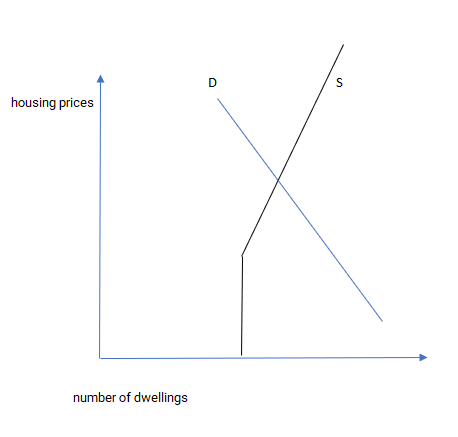
The demand curve (D) shows how many apartments are in demand at a certain price: the horizontal axis shows the number of apartments, while the vertical axis shows the price. Obviously, everyone needs somewhere to live, which means that demand is likely to remain relatively high despite rising prices, writes Zsiday. This is why the demand curve is steep: even with significant price movements, the number of apartments needed does not change significantly. As for the supply curve, it is not really possible to build new apartments below a certain price, so if the price of used apartments is significantly lower than that of new ones, nothing will be built, meaning that the housing stock (supply) will remain fixed. However, later on, when prices rise, new construction will start and the housing stock will increase (Figure 1).
There is clearly a supply problem in Hungary: very few homes are being built (Figure 2: rate of new home construction in OECD countries, 2011 and 2022), despite the fact that prices have risen significantly in recent years, even though such a large price increase should lead to more homes being built and an increase in supply. Regulation, government intervention, the emigration of skilled professionals, and certainly other factors probably play a role in this, but based on market price/quantity indicators, we can rightly assume that
the Hungarian housing market is struggling with supply difficulties, not demand difficulties, which is why I drew a fairly steep supply curve,
emphasizes Viktor Zsiday.

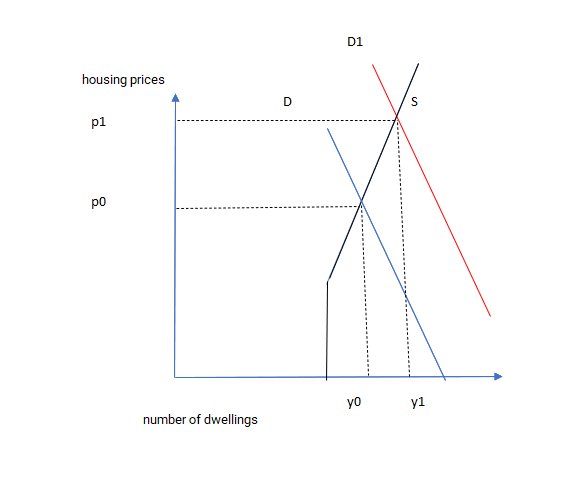
What happens when we unleash additional demand on a tight market with supply constraints (as the government has done with almost all of its housing market programs to date, and will do with the 3% preferential interest rate loan program)? This is what the third figure attempts to demonstrate (in this and the following figure, blue and black represent the original demand and supply curves, while red represents the demand and supply curves that change as a result of government intervention). Obviously, there will be some increase in supply over time (new housing construction: difference between y1 and y0), but prices will also jump significantly (difference between p1 and p0).
This is good for those who already own a home, perhaps even several as savings/investment vehicles, i.e., the wealthy. For the less well-off (young people, those on lower incomes), this is a terrible blow.
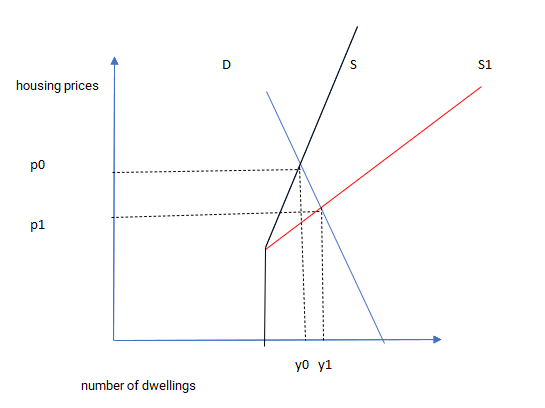
If we want to help them, we need to stimulate supply, not demand. This is what Figure 4 attempts to illustrate. In this case, the housing stock expands as prices fall. To be fair, it should be added that housing market prices are typically sticky on the downside, meaning that in this case, prices are more likely to remain unchanged for years (in nominal terms, but may decline in real terms).
The economist believes that the government's interventions in the housing market in recent years have been almost exclusively demand-side, and the new 3% loan is no exception: it favors the wealthy and disadvantages the poor, and its most significant result is driving up prices. Instead, supply-side intervention is needed* if we really want to do something about the housing market, where the rate of new construction is exceptionally low by European standards. From a social perspective, there is no point in stimulating demand in the housing market again and again.
*these are just a few examples, but professionals/professional organizations working in this field can certainly provide more accurate and specific information on what could increase supply:
- higher housing density, permission for taller buildings
- public infrastructure development in designated residential areas
- accelerating/facilitating approvals for developers
- expert training courses
- ensuring equal market opportunities and treatment for all developers, total elimination of corruption and favoritism
- state housing construction program and/or
- mandatory state offering of part of market projects for rental housing purposes
- support for innovative construction techniques.
Cover photo (for illustration purposes only): Portfolio


