Europe is no longer at the crossroads


The choice was not Europe’s, it was done for us, the question is only whether we stay in the status of denial and try to climb back into the lukewarm bathtub or start to go the new road. Both will be difficult after the shock cause by Trump, no doubt. Looking at the Kübler-Ross phases of grief (denial is followed by anger, bargaining, depression and final acceptance), the possibilities are bargaining or the acceptance after getting over the depression.
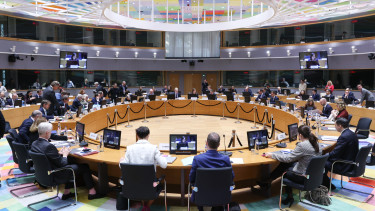
Acceptance, however, is not identical to adaptation. It is through this lens that we should look at the agreements with the Mercosur countries and India and the others that are in progress or come up in the future. This gives also the frame of the latest meeting in a Belgian castle of the European leaders.
According to The Economist the Union is already over the five stages. They, however, considered the reaction to the election of Trump and look at the shocks following it – the humiliation of Zelensky in the White House, the tariffs and the conflict around Greenland – as part of the grieving process and the trade agreement with the US as bargaining and following that, according to them, the Eu has already overcome the depression phase as well.
In my view, however, we are not yet there.
There is namely a chance after Trump – in particular if he loses the mid-term elections, what’s more, then even earlier – that the next US administration turns again with more sympathy towards Europe. In this case there is nothing to be done, just wait fr the tide to turn. This would be staying stuck in the phase of bargaining. The other road is to acknowledge that what Trump finally achieved – Europe has at least recognised that it has to be united eve, when it did not do much in this direction, and realised that it has to widen its connections in the world – several things happened in this direction and it depends on the success of these initiatives whether the EU can adapt to the new situation. The seed of this was the “Geopolitical Commission” – the term coined by Ursula von der Leyen at the start of her first period – but the shock caused by Trump was necessary to take some concrete steps.
Nevertheless, the world starts to recognise that although the American political system is resilient, but cannot prevent on the short term that a president or even a Congress adopts policies which go against the long term interests of the country, or define these interests to harm Europe or other partners, even breaking international rules or, what is more, transforming them. The US had already a president who had no strategy, but the world at that time was simple: it was clear who is friend and foe during the cold war.
The point is that the confidence deficit will stay – and this is justified.
The rearrangement of the fronts is already visible in Europe: till a couple of years ago, there was a strong group of (mainly Eastern-European) countries, which wanted to maintain good relationship with the US even when this meant slowing down European integration and there were Western-European countries fostering illusions toward Russia. The latter see now their scepticism toward the US confirmed while those siding before with America see their suspicions toward Russia vindicated.
Now when every second day it seems that Trump and Putin ally over the head of Europe, the Chinese advances seem less shocking, but due to the economic weight, differing principles and methods of the eastern power, the risks of the Chinese orientation are also visible.
Europe cannot yet behave as a great power, as it is not unified, thus the strategy open for it is the strategy of a mid-sized power.
The solution is to be independent of each great power without antagonising any of them, and partner with those who try to reorient like us. The development of defence capabilities, achieving security of supply and the trade agreements (with the Mercosur countries, India and Viet-Nam, among others) serves this purpose. Showing how new and new developments show that it is necessary to act: an offer from Canada has just arrived while the Trump-Milei agreement makes implementing the Mercosur the more urgent.
The question is whether we are ready for this.
Creating strategic autonomy requires sacrifice, some advantages and comfort have to be abandoned for the sake of competitivity, potential partners, on the other hand, will follow their interests and principles.
On top of that, even these objectives can get in conflict with each other. The security of food supply requires maintaining some branches of agriculture even when importing would be cheaper. Potential partners, at the same time, are interested in exporting their agricultural products. At the same time, the export of the European industry and some specific branches of agriculture compensates for the import (see the dairy industry in the case of Mercosur)
While agricultural producers protested recently against the burden they bear due to climate protection, now voice environmental worries against the Mercosur agreement. The objection is so far justified that while the EU is ready to spend on climate protection, environment and in the interest of other principles, it gives benefits to partners who follow less these principles. This gives a basis for protest also to those who want to reduce climate protection, data protection and similar endeavours. And compromises needed in the interest of the trade agreements are a good occasion for criticism.
These agreements, however, are not only about trade, but serve as a basis for long term economic cooperation.
Therefore it is necessary to undertake some risks (which to a great extent excluded by the recent amendments of the Mercosur agreement anyway) and this is not a too high price. By diversifying agricultural imports dependence can be moderated anyway.
Also, most of the European citizens are not only employees but also consumers. The reduction of prices caused by imports (which can by the way be moderated by antidumping measures and quotas) is advantageous for consumers.
The extraction of rare earths raises environmental worries and the “not in my backyard” attitude enhances the disadvantage of local production already caused by higher labour costs due to the work conditions. Diversifying sourcing – if there are reserves in the partnering countries – decreases the need for own production, but many say that this only exports environmental damage.
Climate and data protection are sensitive topics anyway: industry launched an overall attack to reduce the burden on carbon emission, and removing limits on digital industries and postponing entry into force of obligations play a prominent role in the de-bureaucratisation (Omnibus) package of the Commission.
Many companies consider requirements of data protection, risk reduction and transparency requirements related to tracking website visitors and AI as a limitation. Quality of life is nevertheless also a competitivity factor, as it has great impact on the quality of the workforce.
The problem is that the compromises reached this way are menacing the sustainability and thus the future of industries and services.
What would rather be needed is to indeed reduce the bureaucratic burden – the best way of which would be to harmonise differing member state rules, demolish obstacles before selling and providing services within Europe. The good news is that it seems following the weekend off site meeting of Union leaders that member state leaders have the will to create at least the single financial and capital market and leave out those who are not capable or willing to do this. Looking thus forward to the decisions of the March Eu summit.
Member states did not commit themselves, however, to abolish the bureaucratic barriers and the detail rules going beyond EU rules introduced during their transposition (this has an own name: “gold-plating”) and even less to support the expansion of companies to other member states by harmonising rules – giving up the “holy cows” of national competencies.
Enhancing competitiveness is still only a part of Europe’s “homework”.
Although according to a recent poll more than half of Europeans support increasing defence spending, but there are more and more demonstrations against austerity measures – but costs have to be covered some way. It would be painful to abandon Facebook and other popular US portals as well. Secrtary of State Rubio talked reconciliation in Munich but reiterated the main themes of MAGA – among them retreating from climate and environmental protection, condemning the welfare state and in general the end of the old (rule-based) world order.
Europe has to find itself – not destroying what is common and accepting that the US goes now a different direction. This has its costs, but if we duck it, the consequences will be dearer. Europe was pushed on the road to grow up – the question is only whether it will be an infantile or a mature adult.
Cover image (for illustration purposes only): Getty Images