A new epidemic is on the rise in Hungary too, but what will be its course?


According to the Surveillance Centre report, the number of HAV cases reported in Hungary significantly exceeded the five-year median value from week 48 of 2024 onwards. There was a temporary decline from mid-April to early July 2025, presumably corresponding to the seasonal low point of the disease in spring and early summer. However,
a continuous increase has been observed since the second half of the summer, which coincides with the usual peak of the disease in late summer and autumn.
According to experts at the centre, the seasonal pattern is the same as in previous endemic years, confirming that common transmission factors (e.g. food) do not determine the spread of the virus, which is driven by direct or indirect human contact. This is also supported by the ECDC report of 28 November.
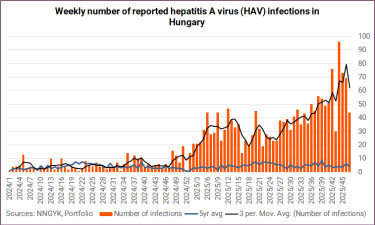
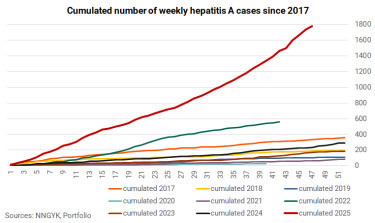
Our data collected from the NNGYK's weekly reports also clearly show how much the current spread of infection differs from previous years.
However, according to the Surveillance Centre's Situation Assessment, time series regional data show that, as reported in the news, Budapest and Pest County were affected at the beginning of the year, while the spread of the virus accelerated in Borsod and Szabolcs counties in the second half of the year.
This shows that the outbreak affected the capital and Pest County. Despite the large population in these areas, measures were successful in slowing down the spread of the disease. However, in areas that had experienced endemic outbreaks in previous decades, such as Borsod-Abaúj-Zemplén and Szabolcs-Szatmár-Bereg counties, where conditions are favourable for the disease to spread (e.g. low levels of drinking water and sewerage provision, poor hygiene practices, etc.), the disease spread more quickly in the second half of the year, in line with the usual seasonal pattern, as was also the case in previous years/decades.
The graph below shows the four most affected areas in Hungary, the capital and three counties. The x axis shows the number of reported HAV cases and the y axis the week on which they were reported.
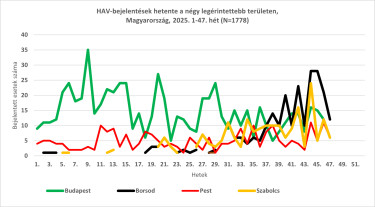
During the year, the majority of cases were registered in four areas: Budapest (38.4%), Pest (12.2%), Borsod-Abaúj-Zemplén (14.0%), and Szabolcs-Szatmár-Bereg (11.4%).
The ECDC said Between January and May 2025, Austria, Czechia, and Hungary reported a higher-than-expected number of hepatitis A virus (HAV) sub-genotype IB cases to EpiPulse. Slovakia started to observe an increase in hepatitis A cases at the end of 2022.
It has been reported that the rise in HAV infections in these countries primarily affects adults experiencing homelessness, people who use or inject drugs, and those living in poor sanitary conditions.
In addition, cases have been reported among members of the Roma communities in both Czechia and Slovakia. ECDC published a Rapid Risk Assessment in June 2025, to further support the public health response in affected countries. By June 2025, a total of 2 100 cases had been reported from Austria (87), Czechia (600), Hungary (530), Slovakia (880) and Germany (3).
The outbreaks of hepatitis A are still ongoing, and the cumulative number of reported cases of HAV in 2025 is now over 6 000, with most cases reported from Austria (216), Czechia (2 310), Hungary (1 548), and Slovakia (2 482).
A total of 39 fatalities have been reported in 2025.
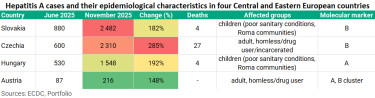
The main groups affected vary from country to country. In Austria and the Czech Republic, for example, a significant proportion of cases have been identified among homeless people and/or drug users. In Hungary and Slovakia, meanwhile, cases have been identified among Roma communities and people living in poor hygienic conditions.
None of the countries have identified any signals of food-borne transmission,
so no common transmission factor has yet been identified; the virus spreads from person to person, or from contaminated surfaces or objects to person.
Sequencing analyses of a subset of the samples have previously identified two closely related clusters, with one nucleotid (nt) difference. The countries report continued circulation of the sub-genotype IB strains addressed in the most recent rapid risk assessment. One cluster (cluster A) currently consists of cases from Austria, Germany, Hungary and Sweden. The reference strain is 3256048 HUN 2025 reported from Hungary. The other cluster (cluster B) now consists of cases from Austria, Czechia, Slovakia, Sweden, England, Wales and Northern Ireland. The reference strain is ENA: ERS23282329/GenBank: OZ223852 reported from Slovakia.
An increase in HAV cases has been observed in Hungary since November 2024. In 2025, a total of 1,548 cases were reported between January and end of October. Of the cases reported so far in 2025, 55% are male and 65% were hospitalised. The age-specific incidence rate was highest among children aged 3-5 years and 6-9 years, but cases were reported in all age groups except neonates. Four fatalities were reported among hospitalised adult cases with comorbidities.
Reports from epidemiological investigations also confirm an increase in HAV cases among people living in Roma communities, and to a much lesser extent, among people experiencing homelessness.
Response by Hungarian authorities
In response to the outbreak in Hungary, surveillance activities have been strengthened, and a nationwide public communication has been issued in 2025. An information letter was distributed to healthcare providers in spring 2025. Post-exposure prophylaxis (free-of-charge vaccination) was provided to contacts of HAV cases. In the affected towns and communities, awareness-raising campaigns were launched, with the support of local municipalities, including the distribution of educational materials in kindergartens and schools.
These efforts focused on emphasising the importance of personal hygiene and ensuring access to handwashing facilities. Vaccination was recommended for individuals belonging to risk groups. All these activities are ongoing and are being adjusted as necessary, based on the local epidemiological situation.
After its announcement in March, the NNGYK issued another statement a few weeks ago. It said that
similar to neighboring countries—Austria, the Czech Republic, and Slovakia—the number of registered hepatitis A cases has increased in Hungary this year.
The NNGYK added that the epidemiological situation is influenced by several factors, including cyclical fluctuations in the disease and an increase in the proportion of the population susceptible to it.
The virus spreads through faeces from infected individuals, through close contact between people living in the same household and through the shared use of toilets in communities. It can also be contracted through water, ice or food contaminated with faecal matter, or through food that has been touched by contaminated hands. In rare cases, the virus can be transmitted sexually.
Thorough hand washing and using antiviral (virucidal) disinfectants on surfaces such as sinks, toilets, door handles and light switches can reduce the risk of spreading the infection.
It is extremely important to follow proper hygiene rules to prevent infection.
In addition, vaccines are available from pharmacies on prescription.
A significant proportion of infections are asymptomatic, meaning people who appear healthy can still transmit the virus. The incubation period is relatively long at an average of one month. The initial symptoms are non-specific and include abdominal pain, nausea, loss of appetite, malaise, fever and muscle and joint pain.
The characteristic symptom is jaundice, which develops later and causes the skin and the whites of the eyes to turn yellow. According to the epidemiological authority, this is often when the possibility of a hepatitis A infection first arises. Asymptomatic infection is particularly common among children. The disease is usually mild, but there is a greater risk of serious illness with advancing age and in the case of chronic disease.
The patient excretes the virus in their stool during part of the incubation period and while they are experiencing initial symptoms. They can therefore infect others, which is why it is important to follow hygiene rules at all times, regardless of whether there are any patients with hepatitis A in our environment. Developing proper hand-washing habits in childhood is particularly important, with special attention given to washing hands after using the toilet and before eating.
About the disease
HAV is highly transmissible through contaminated water, food, and via the faecal–oral route among close contacts (e.g. household contacts, sexual contacts, and contacts in day-care centres or schools), with an average incubation period of four weeks, ranging from two to six weeks. It most commonly occurs in areas with poor hygiene conditions or an inadequate supply of drinking water. HAV is an infectious disease that affects the liver and impairs its function. Acute hepatitis may become chronic after several months if it does not go away. The virus is highly resistant to environmental conditions, and to preservation methods such as acidification or freezing. The primary methods for preventing infection are to practice good hand hygiene and ensure the provision of vaccination to groups at risk of exposure.
Risk groups
According to the ECDC, in the most affected countries,
- the risk remains moderate-to-high for people in the groups who have limited access to proper sanitation and/or healthcare, and
- low-to-moderate for people living in areas with good sanitation standards who have access to healthcare services.
- The risk is very low for people who are vaccinated against hepatitis A or have known immunity to the disease.
The recommendations in the previously published ECDC Rapid Risk Assessment from June 2025 on hepatitis A are still valid. ECDC encourages the public health authorities of the affected countries to focus on the following activities in view of the current multi-country outbreak of hepatitis A:
- enhance surveillance and case detection;
- promote vaccination and strengthen activities to boost vaccination coverage for people who have limited access to proper sanitation and/or healthcare;
- strengthen community engagement and outreach activities to populations more likely to be exposed to the virus
Cover image (for illustration purposes only): Getty Images